What Is an AI Agent? How They Work (and Why They Fail in Production)
An AI agent perceives, plans, uses tools, and acts toward a goal across many steps. How agents work, the 5 components, and why production is the hard part.
An AI agent is a software system that uses a language model to pursue a goal across multiple steps, perceiving its situation, choosing and calling tools, and adjusting based on results, without a human directing every step. That is the definition the field agrees on. What the definition leaves out, and what this page covers, is that an agent is a non-deterministic system whose behavior is emergent, and the gap between a working demo and a reliable production agent is the entire engineering problem.
This page explains what an AI agent is, how the components fit together, where agents sit relative to chatbots and workflows, and the production reality that the optimistic definitions skip.
How Do AI Agents Work?
An AI agent runs a loop. It perceives the current state, reasons about what to do next, acts by calling a tool or the model, observes the result, and loops again until it reaches the goal or hits a stop condition. This perceive-reason-act-observe cycle is the core of almost every modern agent, often implemented with the ReAct pattern (reason, then act, on each turn).
The language model is the reasoning engine at the center, but it is not the whole agent. Anthropic’s “Building Effective Agents” frames the base unit as an “augmented LLM”: a model given retrieval, tools, and memory. The agent is that augmented model plus the control flow that decides when to call which tool and when to stop. The specific shapes that control flow takes, prompt chaining, routing, orchestration, are covered in the build hub.
What Are the Components of an AI Agent?
Five parts show up in nearly every credible definition. The model is one of them, not all of them.
| Component | Role | Example |
|---|---|---|
| Language model | The reasoning core that decides what to do | The model choosing to call a search tool |
| Tools | How the agent acts on the world | APIs, code execution, a database, another agent |
| Memory | Context across steps | In-context for short term, a vector store for long term |
| Planning | Decomposing a goal into ordered subtasks | ”Research X” becomes search, read, summarize |
| Feedback loop | Feeding each result back to re-plan | Observing a failed tool call and trying another |
You will also see the types of AI agents enumerated. The classic taxonomy (simple reflex, model-based, goal-based, utility-based, and learning agents) comes from Russell and Norvig’s Artificial Intelligence: A Modern Approach, the standard reference used to define an agent, and it predates language models. Modern LLM agents, often called agentic AI or simply LLM agents, are a different implementation: rather than hand-written rules, they are built from the five components above, and in practice teams categorize them by how much autonomy they hold, from assistant to workflow to fully model-directed agent, rather than by the classic categories.
AI Agent vs Chatbot vs Workflow
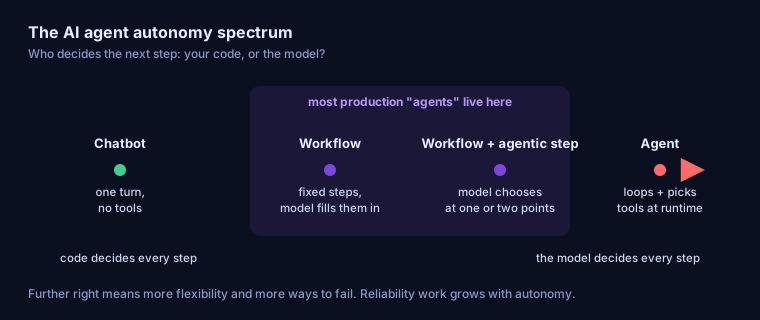
“Agent” is not a binary. It is a point on a spectrum defined by one question: who decides the next step, your code or the model?
| Chatbot | Workflow | Agent | |
|---|---|---|---|
| Steps | One turn | Fixed, predefined | Decided at runtime |
| Tool use | None | Code calls the tools | Model picks the tools |
| Memory | Per conversation | Passed by code | Managed by the agent |
| Fails by | Wrong answer | A step erroring | Looping, drift, compounding errors |
The important and under-told point: most systems marketed as “agents” are actually workflows, fixed steps where the model fills in the blanks, with one or two points where it genuinely decides. That is usually the right design, because workflows are more predictable. It matters because how you test, monitor, and debug a system depends entirely on where it sits on this spectrum.
What Can AI Agents Do? Real Examples
Examples of AI agents, the kind a software team actually ships, take a few concrete shapes:
- Coding agent: reads a GitHub issue, edits files, runs the tests, opens a pull request.
- Customer support agent: reads a ticket, queries a knowledge base, drafts and sends a reply.
- Data agent: ingests a source, detects a schema change, routes the exceptions for review.
- Research agent: breaks a question into parts, runs parallel lookups, synthesizes an answer.
Each is the same loop with different tools. And each looks effortless in a demo and gets hard the moment it runs on inputs nobody anticipated.
Why Are AI Agents Harder Than the Demo?
This is the part the giants’ definitions skip. Three reasons agents are harder than they look.
They are non-deterministic by design. The model at the core samples from a probability distribution, so the same task can produce different outputs on different runs. In a chatbot, one odd reply is a minor annoyance. In a multi-step agent, one wrong tool call in step two corrupts every step after it. Anthropic’s own guidance calls out this “potential for compounding errors” and recommends extensive sandboxed testing for exactly this reason.
They are opaque by default. When an agent does the wrong thing, the failure is buried inside a chain of model calls and tool calls. The most-repeated complaint in Mutagent’s community-research corpus of 7,797 developer pain quotes is this blindness:
“Agent loop debugging is actually hell. No idea where it even broke.” — r/AI_Agents
The reliability gap is the real work. Building an agent that works once takes an afternoon. Making it reliable enough to trust in production, where a 1% error rate compounds and erodes user trust, is a different discipline. You cannot improve what you cannot see, which is why observability is a prerequisite for agents, not an add-on.
How Do You Know If Your Agent Is Actually Working?
Output quality (is the answer right?) is table stakes. In production, the questions that decide whether you can trust an agent are about the loop itself: Is it calling the right tool with the right arguments? Does it know when to stop, or does it spin? When a step fails, does the next step notice? Is it quietly regressing after a model update?
You cannot answer any of these without recording every step of the agent loop, which is what LLM tracing provides, and then measuring outputs against real cases with eval-driven optimization. For the business view of when agents are worth deploying, see AI agents for business.
Next Steps: From Definition to Reliable Agent
An AI agent is a model wrapped in tools, memory, planning, and a loop. That much is easy to understand and easy to demo. The reason agents are a discipline and not a weekend project is everything after the demo: the non-determinism, the compounding errors, and the observability it takes to keep the loop trustworthy.
Mutagent’s autonomous AI Engineer is built for that second half. It traces every step an agent takes, finds where reliability dropped, and proposes the validated fix, so the agent you demoed becomes the agent you can ship. Meet the autonomous AI Engineer to see the loop that keeps agents working in production.
Frequently Asked Questions
What is an AI agent in simple terms?
An AI agent is a software system that uses a language model to pursue a goal across several steps without a human directing each one. It perceives its situation, decides what to do, calls tools such as APIs or code, observes the result, and repeats until the goal is met. A plain chatbot answers one message at a time; an agent strings actions together to complete a task. The model is the reasoning core, but the agent is the whole loop around it: tools, memory, and the control flow that decides when to act and when to stop.
How do AI agents work?
An AI agent runs a loop: perceive the current state, reason about the next step, act by calling a tool or model, observe the result, then loop again until the goal is reached or a stop condition fires. The language model is the reasoning engine, tools are how it affects the world, and memory carries context between steps. This perceive-reason-act-observe cycle is often implemented with the ReAct pattern. The hard part is not the loop itself but keeping it reliable, because each step can fail and the errors compound across the chain.
What is the difference between an AI agent and a chatbot?
A chatbot responds to one message with one reply and has no ability to take action on its own. An AI agent runs many steps toward a goal, chooses and calls tools, keeps memory across steps, and decides when it is done. The practical line is autonomy and action: a chatbot tells you something, an agent does something. Most real systems sit on a spectrum between the two, often a fixed workflow with one or two steps where the model decides, rather than a system that directs itself end to end.
What are the main components of an AI agent?
Five parts. The language model is the reasoning core that decides what to do. Tools (APIs, code execution, databases, other agents) are how it acts on the world. Memory holds context, in-context for the short term and a vector store or database for the long term. Planning decomposes a goal into ordered subtasks. The feedback loop feeds each result back in so the agent can re-plan. The model alone is not the agent; the agent is the model plus the tools, memory, planning, and control flow wrapped around it.
Are AI agents reliable?
Not by default, because the model at the core is non-deterministic: the same input can produce different outputs, and in a multi-step agent one wrong step corrupts everything after it. This is why most agents in production are kept narrow, constrained to a few steps with human checkpoints, and why surveys find most pilots never reach production. Agents become reliable through engineering, not a better model: tracing every step, evaluating outputs against real cases, and continuously fixing the steps that regress.
What does an AI agent do?
An AI agent carries out a goal across several steps instead of answering a single question. It reads the situation, decides on an action, calls a tool such as an API, a search, or code execution, checks the result, and repeats until the task is done. Concretely that looks like a coding agent reading an issue, editing files, running tests, and opening a pull request, or a support agent reading a ticket, querying a knowledge base, and drafting a reply. The defining trait is action: an agent does something, where a chatbot only tells you something.
What are the types of AI agents?
The classic taxonomy from Russell and Norvig lists five: simple reflex, model-based reflex, goal-based, utility-based, and learning agents. That framework predates language models. Teams building with LLMs today usually categorize agents by how much autonomy they hold instead: an assistant that suggests, a workflow where code controls the steps and the model fills them in, and a model-directed agent that picks its own tools and loops at runtime. Most production systems are workflows with one or two agentic steps, because they are more predictable than an agent left to run the whole loop on its own.