Prompt Optimization: Why Tweaking Prompts Doesn't Scale
Prompt optimization is improving a prompt against a measure, not by feel. Learn the manual techniques, why they stall, and how eval-driven optimization works.
Prompt optimization is the work of improving a prompt so a model produces better outputs, measured against a defined criterion rather than judged by feel. Often called prompt tuning, the manual side, clearer instructions, few-shot examples, better structure, is where most people start. The part that actually scales is the measurement: changing a prompt and confirming, against real cases, that it improved the outcome without breaking something else.
This page covers the standard techniques, where they stop working, and how prompt optimization becomes an engineering discipline instead of a guessing game.
What Is Prompt Optimization?
A prompt is configuration. It controls how a model interprets a task, what format it returns, which tool it picks, and how it handles edge cases. Prompt optimization is changing that configuration to get a better result, and knowing that it is better.
That last clause is the whole game. Rewriting a prompt until the one example in front of you looks good only proves that one example improved. Optimization is when the change is measured against a set of cases that represents what the model actually sees in production.
The Manual Techniques, and Where They Stop
The standard techniques are real and worth using. They are the starting point, not the finish line.
- Clear, specific instructions: state the task, the constraints, and the output format directly. Most early wins come from removing ambiguity.
- Few-shot examples: show two or three labeled examples of the input-output pattern you want. This steers behavior more reliably than describing it.
- Structured output: ask for a defined schema (JSON, fields) when the result feeds code, and the downstream failures drop.
- Decomposition: split a complex instruction into steps the model handles one at a time.
These get a prompt from bad to decent. Where they stop is scale and confidence. You cannot tell, by reading, whether your latest edit helped on the 200 inputs you did not look at. And the moment a prompt is doing real work, the failure that matters is the one you cannot see.
Why Tweaking Prompts Doesn’t Scale: The Regression Problem
A prompt controls many behaviors at once, so a change aimed at one of them moves the others. You add a line to fix a formatting bug, and routing accuracy shifts on inputs you were not testing. In Mutagent’s optimization work, a single word change has moved routing accuracy by double digits, in both directions. The mechanism is easy to picture: adding “be concise” to fix verbose answers can also truncate the step-by-step reasoning the model needed on the hard inputs, so short questions improve while complex ones quietly degrade. You fixed the case you were looking at and broke the case you were not.
That is prompt regression, and it is the reason manual tweaking plateaus. Without a way to measure the whole behavior, every fix is a coin flip between net-better and net-worse. The corpus bears this out: across Mutagent’s community-research data, the recurring pattern around model output is failures that surface only in production. Structured-output breaks are the most common, perceived quality regressions after a change come next, and underneath both sits the eval gap, the teams that have no evaluation set to catch any of it.
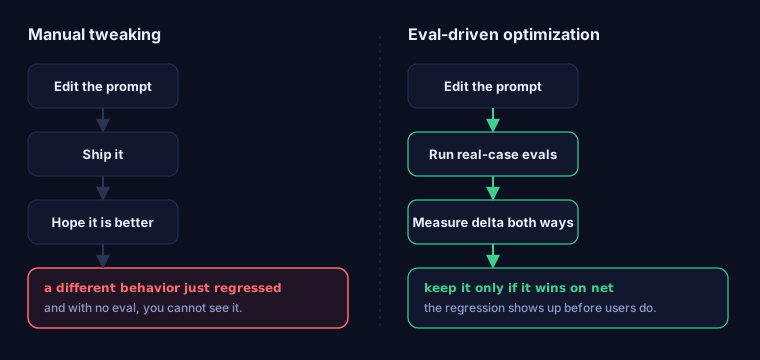
The edit-and-ship loop on the left hides regressions by design: there is no point at which the change is measured against anything but the case you were debugging. The loop on the right makes the regression visible before users do.
Eval-Driven Prompt Optimization
The fix is to stop optimizing on one example and start optimizing against a set. The discipline has three parts:
- Build an evaluation set from real cases. Pull the inputs that matter from your production traces, the failures you are fixing and a sample of cases that already work, so a regression has somewhere to show up. This is why prompt optimization is an observability problem first: you cannot optimize against data you never captured.
- Score both versions on the same set. Run the current prompt and the candidate against the evaluation set with a measure that fits the task. For structured output, that is exact match or schema validity, did it return the right fields in the right shape. For classification, routing, and extraction, it is a task-specific check, did it pick the right tool or pull the right value, scored against a labeled answer. For open-ended generation where no single answer is correct, it is an LLM-as-judge rubric: a second model scoring each output against explicit criteria you define. Pick the measure that reflects the outcome, not a proxy like response length, and compare the net result across the whole set, not the target case in isolation.
- Keep it only if it wins on net. A change ships when it improves the set overall, accounting for anything it regressed. Otherwise it gets reverted, with the evidence to say why.
Done this way, prompt optimization stops being a practice you trust by feel and becomes a measured change you can defend. It also becomes automatable: once the evaluation set exists, you can generate and test variants against it instead of editing by hand. The bottleneck is never the variants, it is the quality of the evaluation set drawn from real data.
How Do You Optimize a Prompt Systematically?
A repeatable loop, whether you run it by hand or automate it:
- Capture the real cases, including the current failures, from production traces.
- Define the measure that reflects the outcome you want, not a proxy.
- Change one thing in the prompt, with a hypothesis for why it should help.
- Score both versions against the full set and read the net delta.
- Keep or revert on the evidence, and log the result so the next change starts from a known baseline.
This is the loop Mutagent’s autonomous AI Engineer runs continuously: it builds the evaluation set from your traces, generates and tests prompt changes against it, and surfaces the version that wins on net, with the regression check built in. It turns prompt optimization from an afternoon of tweaking into a measured, repeatable step.




Next Steps
Prompt optimization is the discipline of measuring a change before you trust it. Clever phrasings are the easy part; the measurement is what separates a durable gain from a lucky one. The teams that compound results are the ones who optimize against real cases, not the example in front of them.
That measurement starts with capturing the right data. See LLM tracing for the trace pipeline that feeds it, or meet the autonomous AI Engineer to see the full optimize loop in action.
Frequently Asked Questions
What is prompt optimization?
Prompt optimization is the process of improving a prompt so a language model produces better outputs, measured against a defined success criterion rather than judged by feel. It covers manual techniques like few-shot examples and clearer instructions, and systematic ones like running prompt variants against an evaluation set and keeping the version that scores higher. The defining feature of real optimization is that the improvement is measured, not assumed.
What is the difference between prompt engineering and prompt optimization?
Prompt engineering is the broad practice of writing prompts: structure, instructions, examples, formatting. Prompt optimization is the narrower, measurable part: changing a prompt and confirming, against a benchmark of real cases, that it actually improved the outcome without breaking something else. Engineering produces the candidate; optimization decides whether the candidate is better.
Why does improving one prompt break another behavior?
Because a prompt controls many behaviors at once. Adding an instruction to fix one failure can change tone, formatting, or routing on inputs you were not looking at. This is prompt regression, and without an evaluation set spanning your real cases it is invisible: you ship the fix, the target case improves, and a different case quietly degrades. The only reliable defense is measuring the change across a representative set, not just on the example you were debugging.
Can prompt optimization be automated?
Yes. Automated approaches generate and test prompt variants against an evaluation set and keep the best performer, removing the manual edit-and-hope loop. Generating variants is the easy part; the hard part is having a trustworthy evaluation set drawn from real production cases and a measure that reflects what you actually care about. Automation amplifies a good eval and amplifies a bad one just as fast.
How do you measure whether a prompt change is an improvement?
Build an evaluation set from real cases, including the failures you are trying to fix and a sample of cases that already work. Score the current prompt and the candidate against the same set, and compare the net result, not just the target case. A change is an improvement only if it wins overall, accounting for anything it regressed. Without that both-ways measurement, you are optimizing on one example and hoping the rest held.
How big does an evaluation set need to be?
Smaller than people expect to start, but representative. A few dozen cases that cover your real input distribution, including the failure modes you care about and the common happy paths, is enough to catch most regressions and is far better than no set at all. Grow it over time by adding every new failure you find in production as a permanent case, so the same regression can never ship twice. Coverage of the behaviors that matter beats raw count: 50 well-chosen cases catch more than 500 near-duplicates.
What metric should I use to score a prompt?
Match the metric to the task. Use exact match or schema validity for structured output, a task-specific check against a labeled answer for classification, routing, and extraction, and an LLM-as-judge rubric for open-ended generation where there is no single correct answer. Avoid proxies like response length or a generic quality score that do not reflect the real outcome. The metric is the steering signal, so a weak metric produces weak optimization no matter how many variants you test.