AI Agents for Business: The Use Cases That Work (and What It Takes to Run Them)
AI agents for business: the use cases delivering value, why most pilots stall before production, and the reliability work that decides whether you see ROI.
AI agents for business are systems that use language models to carry out real work across functions, customer service, data analysis, coding, document processing, and more, taking actions across multiple steps rather than just answering questions. The use cases are well understood and the demos are convincing. The part that decides whether you see any business value is what happens after the demo: most agent pilots never reach production, and the reason is rarely the use case.
This page covers what agents are actually deployed for, why so many pilots stall, and what separates the ones that make it. If you need the underlying concept first, start with what is an AI agent.
What Are AI Agents Used for in Business?
Most teams reach these through one of two routes: building on a framework, or buying into an AI agent platform or agent builder that ships the orchestration for them. Either way, the deployments cluster into a stable set of functions. Across vendor reports the same categories appear, ranked roughly by how often they show up:
| Function | Typical agent task |
|---|---|
| Customer service | Read a ticket, query a knowledge base, draft and send a reply |
| Data analysis | Pull data, summarize, flag anomalies for review |
| Code generation and review | Read an issue, edit files, run tests, open a pull request |
| Document processing | Extract, classify, and route documents |
| Sales | Research a prospect, draft outreach, update the CRM |
| IT operations | Triage alerts, run diagnostics, escalate |
| HR | Answer policy questions, process routine requests |
The common thread among the use cases that work is high-frequency, repetitive work with a bounded set of decisions and a clear notion of a correct result. That is table stakes, though. Picking a good use case is the easy decision. The hard one is whether you can keep the agent reliable once it leaves the demo. For how enterprise AI agents are actually built, see the build hub.
Why Do Most AI Agent Pilots Fail to Reach Production?
A working demo proves the use case is feasible. It does not prove the agent is reliable at scale, and the gap between those two is where most projects die.
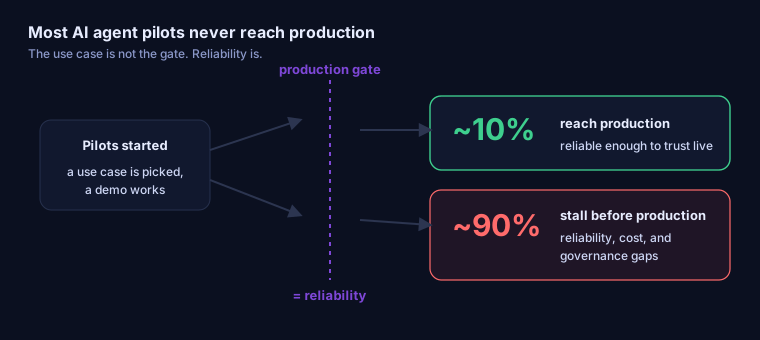
The numbers are stark. An MIT NANDA study widely covered in 2025 found that about 95% of organizations were getting no measurable return from their generative AI investments. A Cleanlab survey of 1,837 engineering and AI leaders found only about 5% had agents live in production at all. Analyst Drew Breunig, synthesizing the 2025 enterprise data, draws the through-line for agents: most internally built pilots never reach production, and reliability, not the use case, is the gate.
The lesson is not that agents do not work. It is that the production gate is real, and it is a reliability gate, not a use-case gate.
Which Failures Stall Agent Pilots Before Production?
Three failure modes show up again and again, and none of them is the use case.
Reliability degrades outside the test environment. An agent that handles fifty cases cleanly in a demo meets inputs in production it never saw, and a single confident wrong answer does lasting damage:
“Agent nailed 50 tickets in a row. Ticket #51: confidently wrong answer about pricing. That 1% doesn’t just break one interaction, it poisons future trust.” — r/AI_Agents
Cost is higher and less predictable than the estimate. Teams budget for the model’s API cost and get surprised by what running an agent reliably actually takes:
“A regression after updating my prompt, no idea when it broke. $80 in API costs on a task I thought would cost $8.” — r/AI_Agents
Governance is missing. Without limits and oversight, an agent can do real damage at machine speed. One catalog of production failures in the corpus describes “no circuit breakers, so loops ran until they hurt: a content agent published the same post 47 times because there was no retry limit and no gatekeeper.” Security and governance gaps are among the most common clusters across Mutagent’s community-research corpus of 7,797 developer pain quotes.
What Separates the Agents That Make It?
The teams that get agents into production and keep them there share a pattern, and it is operational, not magical.
- Observability first. Every step the agent takes is traced, so a failure is located, not guessed at. In the Cleanlab survey, teams running agents in production ranked improving observability and evaluation as their top investment priority for the year ahead.
- Continuous evaluation. Outputs are scored against real cases on an ongoing basis through eval-driven optimization, so a regression is caught before users feel it. Demo-time quality is not production quality.
- Clear ownership. A named person is accountable for the agent’s behavior after launch, with baseline metrics captured before the pilot so “better” and “worse” mean something.
This is the same Monitor, Diagnose, Optimize loop that keeps any production agent reliable. The ROI that vendors advertise is real, but it accrues to the agents that clear this bar, not to the ones that demo well and stall.
Which Business Use Cases Are Best Suited to AI Agents?
Once you accept that reliability is the gate, use-case selection changes. The question is no longer “can an agent do this,” but “can this be made reliable enough to keep in production.” The filter is whether the output is observable and checkable.
- High suitability: customer service, data analysis, document processing, code review. The output is visible, ground truth is reachable, and you can measure quality continuously.
- Low suitability: open-ended strategic reasoning and planning. There is no clean correct answer to evaluate against, so you cannot tell when the agent regresses.
A practical test before you commit: can you write the check that says whether the agent did its job? If you can, you can trace it, evaluate it, and keep it reliable. If you cannot, the use case will fight you at the production gate no matter how good the demo looked.
Next Steps: Value Lives Past the Production Gate
AI agents create business value where the work is repetitive, the volume is high, and the output is checkable. But the value is realized on the far side of the production gate, and that gate is reliability. The use cases are the easy decision; the operational discipline of tracing, evaluation, and ownership is what turns a promising pilot into a system you can trust.
Mutagent’s autonomous AI Engineer is built to carry agents across that gate. It traces what an agent does at every step, finds where reliability drops, and proposes validated fixes, so a working pilot becomes a production system instead of another stalled experiment. Meet the autonomous AI Engineer to see how agents earn their place in production.
Frequently Asked Questions
What are AI agents used for in business?
The most common business deployments are customer service and support, data analysis and reporting, code generation and review, document processing, sales prospecting, IT operations, and HR process automation. The pattern that wins is high-frequency, repetitive work with a bounded range of decisions and a clear notion of a correct result. Open-ended judgment tasks are far harder to run reliably. The use case is rarely the hard part, though; the hard part is keeping the agent reliable once it handles real volume, which is what separates a pilot from a production system.
Why do most AI agent pilots fail to reach production?
Because a demo proves the use case is possible, not that the agent is reliable at scale. An MIT NANDA study widely covered in 2025 found about 95% of organizations getting no measurable return from generative AI, and analysts synthesizing the 2025 data conclude most internally built pilots never reach production. The blockers are consistent: behavior that degrades outside the test environment, cost that turns out higher and less predictable than the API estimate, and missing governance. The deciding factor is not which use case you pick; it is whether you have the observability and evaluation to keep the agent trustworthy in production.
What is the ROI of AI agents for business?
Real, but it accrues only to the agents that reach and stay in production. Vendors cite large productivity gains for deployed agents, but those numbers come from the minority of projects that cleared the reliability bar. Total cost of ownership is also higher than the raw model bill once you add observability, orchestration, evaluation, and the engineering time to keep the agent reliable. The honest ROI question is not the best-case projection; it is whether your team can move a pilot through the production gate and keep it working, which is where most of the value and most of the risk sit.
What makes an AI agent production-ready for business?
Three things beyond a working demo. Observability: every step the agent takes is traced, so a failure can be located rather than guessed at. Evaluation: outputs are scored against real cases continuously, so a regression is caught before users feel it. Ownership: a person is accountable for the agent's behavior after launch, with baseline metrics captured before the pilot. Surveys of teams running agents in production rank observability and guardrails as their top investment priority, because reliability, not the use case, is what keeps an agent live.
Which business use cases are best suited to AI agents?
The ones with an observable, checkable output and a short feedback loop. Customer service and data analysis score well: the result is visible, ground truth is reachable, and you can measure quality continuously. Document processing and code review are similar. Open-ended strategic reasoning scores poorly, because there is no clear correct answer to evaluate against, so you cannot tell when it regresses. A useful filter before committing: can you write the test that says whether the agent did its job? If not, reliability, and therefore ROI, will be hard to defend.