Agentic Architecture: Choose Patterns by How They Fail
Agentic architecture explained: the four multi agent architecture patterns, when a single agent wins, and how to contain coordination failures.
Agentic architecture is the structural layer of an AI agent system: how models, tools, memory, and control flow are arranged so the thing can pursue a goal without a person driving every step. Most guides present the patterns as a menu of capabilities. This page presents them the way production teams learn to read them, by their failure modes, because in a multi agent architecture the design choice you are really making is where failures land and how far they spread.
What Is Agentic Architecture?
Every agentic system, from a single assistant to a fleet, is built from the same parts. A reasoning model decides what to do next. Tools let it act. Memory carries state beyond the context window. A control loop feeds results back in. Agentic architecture is the arrangement of those parts, and the first architectural decision is not which pattern to pick but whether to distribute at all.
The spectrum runs from one model in a tool loop, through a single agent with subagents for parallel reads, to full multi agent ai systems where specialized agents hold separate contexts and coordinate through messages or shared artifacts. Complexity rises at each step, and so does the surface area for a new class of failure that single systems cannot have: two agents disagreeing about state.
A useful way to hold the term is that agentic architecture answers structural questions and only structural ones. Which agents exist, what each is allowed to touch, how context flows between them, and where the boundaries sit. The runtime questions, who runs next and when everything stops, belong to orchestration, and conflating the two is how teams end up redesigning their structure to fix what was actually a missing timeout.
Memory placement is the structural decision that gets skipped most often. Each agent needs working state for its own task, the fleet needs shared state for hand-offs, and the two must not be the same store. Shared mutable memory between agents recreates every race condition distributed systems spent decades learning to avoid, now with a non-deterministic writer on both sides. The designs that hold up give each agent private scratch space and make everything shared an immutable artifact with one writer, so a corrupted intermediate can be traced to the agent that produced it instead of being everyone’s fault at once.
What Are the Core Multi Agent Architecture Patterns?
Four patterns account for nearly every production multi agent system architecture. The capability column is what the diagrams advertise. The failure column is what you will actually spend your time on.
| Pattern | How it works | Characteristic failure | Containment |
|---|---|---|---|
| Orchestrator-worker | Lead agent decomposes, delegates, merges | Orchestrator stalls or loops, everything stalls | Budgets and timeouts on the lead |
| Router | Classifier sends each request to a specialist | Misrouting, silent because the wrong agent still answers | Log routing decisions, eval them |
| Hierarchical | Supervisors over domain agents over workers | Context degrades at every hop, blame gets lost | Trace IDs across all hops |
| Critic-refiner | Producer output reviewed and iterated | Endless revision loops on subjective criteria | Iteration caps, objective pass criteria |
The multi agent frameworks you would build these with, graph-based orchestration libraries, role-based crew frameworks, or the subagent machinery in the Claude Agent SDK, all implement the same four shapes. The framework choice matters less than the pattern choice, and the pattern choice is a bet on which failure you would rather debug.
Patterns also compose, and real systems usually blend two. A router in front of several orchestrator-worker cells is the standard shape for a product with distinct task families. A critic bolted onto an orchestrator’s merge step buys quality control without restructuring anything. Composition multiplies the failure modes along with the capabilities though, so each added pattern should answer a measured problem, not a diagram’s sense of completeness. The strongest agentic architecture is generally the least architecture that fits the task.
When Does Multi Agent Beat Single Agent?
The best public evidence comes from Anthropic’s write-up of their multi-agent research system. A multi-agent setup with a lead agent and parallel subagents outperformed a single-agent baseline by 90.2 percent on their internal research eval. The same post reports the bill: agents use about 4 times the tokens of a chat, and multi-agent systems about 15 times, with token usage alone explaining 80 percent of performance variance on one benchmark.
The post also states the boundary plainly. Domains where agents must share full context, or that involve many dependencies between agents, are a poor fit today, and most coding tasks have fewer truly parallelizable pieces than research does. That gives you an honest decision rule. Distribute when subtasks are independent and read-heavy, and the task value covers a double-digit token multiplier. Stay single-agent when state is tightly coupled, and get parallelism from subagents inside one loop instead.
The migration path matters as much as the destination. Teams that succeed with multi agent architecture almost never start there. They start with one agent, instrument it until its failures are legible, and split only when a measured bottleneck says the work partitions, so the fleet inherits working evals and traces instead of multiplying an unmeasured system by five. Going multi-agent to escape a single agent’s reliability problems reliably produces five unreliable agents and a coordination layer.
Why Coordination Is the Real Cost
Builders who run these systems report a failure class that no agentic architecture diagram shows. In Mutagent’s community-research corpus, coordination chaos and debugging blindness both rank among the most-reported clusters, and both describe exactly the situation multi-agent systems create: a failure surfaced far from its cause, with no record connecting them.
The economics compound the debugging problem. Every coordination hop re-sends context, so token spend scales with the number of hand-offs rather than the size of the task, and a chatty multi agent architecture can spend more tokens on agents briefing each other than on the work itself. Budget the coordination overhead explicitly when comparing designs. A single agent that solves the task at one fifteenth the token cost is not a lesser design. It is usually the correct one, and the fleet has to earn its multiplier with capability a single context cannot reach.
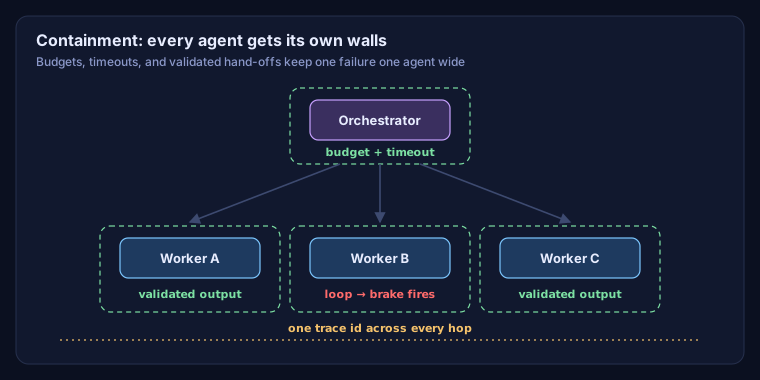
Containment is the design answer. Give every agent its own budget and timeout so one runaway loop cannot consume the fleet. Make hand-offs explicit artifacts rather than shared mutable state. Keep the blast radius of a bad output one consumer wide by validating at boundaries. These constraints cost little at design time and are nearly impossible to retrofit after the first production incident.
Walk one incident to see why. A research fleet’s lead agent delegates ten source-gathering tasks. One worker hits a paywalled site, retries in a loop, and burns its context window. Without containment, the lead waits on it forever and the whole run hangs, the exact stuck-run failure that tops the corpus. With per-worker budgets, the worker gets killed at its cap, the lead notes one missing source and merges nine results, and the trace shows precisely which agent died and why. Same architecture on paper. The walls are the difference between a degraded answer and a dead system.
How Do You Keep a Multi Agent System Observable?
A multi agent architecture is only debuggable if one request can be followed across every agent it touched, which makes a shared trace ID propagated through every hop the non-negotiable first step. Per-agent tracing turns “the pipeline gave a wrong answer” into “the router misclassified, so the wrong specialist answered,” which is the difference between an afternoon and a week.
Evaluation follows the same per-role split. Score the router on routing accuracy, workers on task completion, and critics on catch rate, because a single end-to-end score cannot localize which role regressed. The runtime half of this problem, deciding when agents run and when they stop, is its own discipline covered in the orchestration guide, and the patterns pair with the agentic workflow foundations.
Treat observability as an acceptance criterion for the design itself. If you cannot say where a request is, which agent owns it, and what it has cost so far, the agentic architecture is not done, however elegant the diagram. That standard is easy to meet at design time and brutal to retrofit, which makes it the cheapest architectural decision on this page.
One last principle ties the page together. The best agentic architecture is not the one with the most agents or the cleverest topology. It is the one whose failures you can see, contain, and attribute, which usually means the simplest structure that meets the requirement. Start with a single agent, add roles only when a measured limit forces the split, wall each new agent off with its own budget and validated hand-offs, and thread one trace through the whole thing. A design chosen that way survives contact with production. A design chosen for elegance meets the coordination and debugging failures at the top of the field data, on schedule.
Mutagent’s agents instrument exactly this layer, building per-role evals and diagnostics from the traces your architecture produces.
Frequently Asked Questions
What is agentic architecture?
Agentic architecture is the structural design of an AI agent system: how models, tools, memory, and control flow are arranged so the system can pursue goals autonomously. It spans one model in a tool loop up to a multi agent system architecture of collaborating specialists, and the choice determines how the system fails as much as what it can do.
What is the difference between single agent and multi agent architecture?
A single agent runs one model in one loop with one context, which keeps state coherent and debugging tractable. A multi agent architecture distributes the work across specialized agents that coordinate, which buys parallelism and separation of concerns at the cost of coordination overhead, shared-context loss, and roughly an order of magnitude more tokens.
When should you use a multi agent system?
When the work parallelizes into independent subtasks that do not need to share full context, research and broad reading being the canonical cases. Anthropic measured a multi-agent research system outperforming a single agent by 90.2 percent on their internal eval, while using about 15 times the tokens of a chat. Tightly coupled work, like most coding, favors a single agent.
What are the main multi agent architecture patterns?
Four patterns cover most real systems. Orchestrator-worker has a lead agent decompose and delegate. Router sends each request to the best-fit specialist. Hierarchical stacks supervisors over domain agents for scale. Critic-refiner pairs a producer with a reviewer that iterates until quality passes. Each has a characteristic failure mode that should drive the choice.