AI Agent Orchestration: The Job Is Mostly Knowing When to Stop
AI agent orchestration coordinates agents through one control loop. Learn the patterns, the termination problem, and what to instrument before you scale.
AI agent orchestration is the coordination layer that turns agents into a system: it decomposes goals, routes tasks, carries context between steps, and enforces the rules of execution. Vendor definitions like to compare the orchestrator to a conductor leading a symphony. The metaphor flatters the job. In production, most of what an orchestrator does is less like conducting and more like braking, because the single most common way agent systems fail in the field is by not stopping.
What Does AI Agent Orchestration Do?
Strip the marketing and agent orchestration has four responsibilities. It breaks an objective into tasks. It assigns each task to the agent, tool, or human best placed to do it. It moves context between steps so progress does not reset at every hand-off. And it enforces guardrails, deciding what runs automatically, what needs approval, and what must halt the run.
Coordination models split into three families. Centralized orchestration puts one controller in charge of assignment and sequencing, which is auditable and simple to reason about but concentrates risk in one place. Distributed orchestration lets agents negotiate work among themselves, which removes the bottleneck and makes system behavior harder to predict. Hybrid keeps global rules central and local decisions autonomous. Enterprise platform pages document these shapes well enough. What they consistently leave out is the operational half, and that half starts with termination.
Why Termination Is the First Design Problem
In Mutagent’s community-research corpus, the most-reported failure of all is the agent stuck in a loop or hang, ahead of every hallucination, quality, and cost cluster. Builders do not primarily report agents doing the wrong thing. They report agents that never finish.
The loops have recognizable anatomies. An agent retries a failing tool with the same arguments forever. Two agents delegate to each other in a cycle. A critic rejects every draft against criteria no draft can meet. A tool call hangs and nothing above it carries a deadline. None of these are model failures, and every one of them is an orchestration failure, preventable by the control loop rather than the prompt.
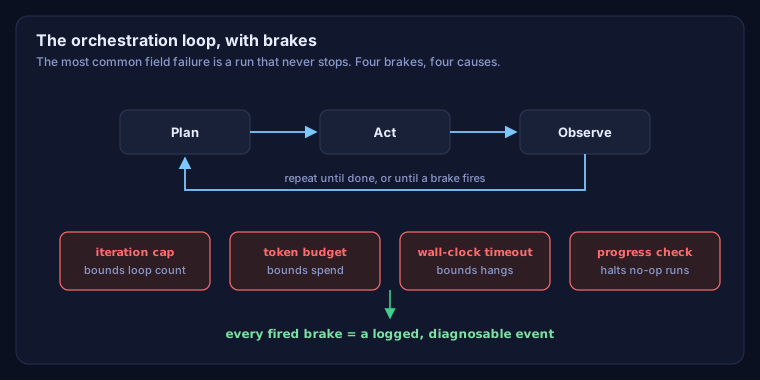
The defense is four independent brakes on every run. A hard iteration cap bounds the loop count. A token or cost budget bounds spend. A wall-clock timeout bounds hangs. Progress detection halts runs where consecutive steps change nothing. Each brake catches a loop the others miss, which is why mature orchestrators ship all four and treat a fired brake as a logged, diagnosable event rather than a silent restart.
Walk one loop through the brakes to see the division of labor. An agent calls a search tool, gets an empty result, reasons that it should search again, and issues the same query. Nothing errors, tokens burn steadily, and each step completes quickly, so the timeout never fires. The iteration cap would end the run eventually, at whatever generous number it was set to. The budget would end it sooner if the queries were expensive. But the progress check ends it on the third identical call, because state has not changed, and it ends the run with the most useful diagnosis of the four: this agent was stuck, at this step, repeating this exact action. Brakes are not redundant safety theater. Each one is a different sensor, and the one that fires tells you what kind of loop you had.
How Does AI Agent Orchestration Handle Context?
Between stopping problems, the orchestrator’s day job is moving context. Every hand-off between agents is a decision about what the receiving agent needs to know, and both failure directions are expensive. Pass everything and each hop bloats the context window until quality drops and cost spikes. Pass too little and the receiving agent re-derives or invents what it was not told, which is how a fleet produces confident answers built on missing premises.
The working practice is to make hand-offs explicit artifacts with a defined shape: the task, the constraints that survive from the original goal, the relevant results so far, and nothing else. Compaction summarizes long histories at the boundary instead of forwarding them raw. The orchestrator owns this contract, and ai agent orchestration quality in practice tracks the quality of these hand-offs more closely than it tracks any routing algorithm, because a perfectly routed task with a broken context contract still fails.
Which Orchestration Pattern Fits?
Match the coordination model to the failure you can afford. Centralized control fails loudly at one point, so it fits regulated flows and anything needing an audit trail, and its orchestrator deserves the tightest budgets in the system. Hybrid earns its complexity once specialist teams of agents need local autonomy under global spend and safety rules.
Distributed coordination degrades instead of stopping, which suits high-volume independent tasks but makes multi agent orchestration failures hard to reconstruct after the fact. Whichever shape you pick, orchestration is the runtime complement to structure. The structural side, which agents exist and how they relate, is covered in the multi-agent architecture guide, and the step-level foundations live in agentic workflows.
A second-order decision hides inside the pattern choice: where humans sit in the loop. Mature agent orchestration treats human attention as a routed resource like any other, with explicit escalation rules. Actions above a cost threshold pause for approval. Confidence below a floor routes to review instead of retry. A brake firing twice on the same task stops being a retry candidate and becomes a ticket. Systems without these rules do not avoid human involvement. They just receive it as incident response instead of as a designed checkpoint.
What Do Orchestration Frameworks and Platforms Provide?
The ai agent orchestration frameworks you will evaluate are mostly control-flow libraries: graph-based engines where agents are nodes and edges encode routing, role-based crew frameworks, and the subagent machinery inside the Claude Agent SDK. They give you the loop, the state passing, and the retry scaffolding.
An ai agent orchestration platform layers operations on top: an agent registry, permissions, human approval flows, and dashboards. The honest read on both categories is that they provide the mechanism and leave the policy to you. No framework knows your iteration caps, budgets, or escalation rules. Those are design decisions, and teams that skip them ship the most-common failure mode with excellent scaffolding around it.
Setting the initial policy values is less delicate than it looks. Take a week of traced runs, find the distribution of steps and tokens for successful completions, and set each brake at roughly three times the 95th percentile. Caps set that way almost never clip legitimate work, still bound the damage of a runaway loop to a known cost, and give you a defensible starting point to tighten from as evidence accumulates. The teams that struggle are not the ones with imperfect thresholds. They are the ones who deferred choosing any, because an unbounded loop only reveals itself as a design gap on the day it becomes an invoice.
What Should You Instrument?
Orchestration is only debuggable through its traces. Propagate one trace ID across every agent, tool call, and hand-off so a stuck run can be opened to the exact step where progress ended, the practice covered in the LLM tracing guide. Emit budget counters, iteration counts, and brake events as first-class metrics, and alert on runs that approach their caps rather than runs that hit them, since the approach is the early warning.
Then evaluate the orchestrator itself. Routing decisions, decomposition quality, and stop decisions are all judgeable outputs, and scoring them is how agent orchestration improves rather than accretes. A routing eval is a labeled set of tasks with known best-fit agents. A decomposition eval checks whether subtasks cover the goal without overlap. A stop-decision eval replays completed runs and asks whether the orchestrator halted at the right step. None of these require new infrastructure beyond the traces you already collect, and together they turn the control loop from a config file nobody dares touch into a component that can be changed with evidence.
The maturity curve for ai agent orchestration is predictable across teams. First runs work in demos and hang in production. Then brakes get added after the first stuck-run incident. Then traces make the brakes diagnosable. Then evals make the orchestrator improvable. Teams that walk that curve deliberately compress months of incident-driven learning into the design phase.
The through-line of the whole page is that orchestration is where agent systems earn their reliability or lose it, and the reliability comes from unglamorous parts. Not a smarter router or a cleverer topology, but the four brakes, the context contract, the escalation rules, and the traces that make all three legible. A system with those pieces and an average model outperforms a system with a frontier model and none of them, because the frontier model still loops, still bloats context, and still fails silently, only faster. Build the control plane first and the intelligence has somewhere safe to run. Mutagent’s agents run the later stages of that loop on your traces, from diagnosing where runs stall to gating orchestrator changes on measured regressions.
Frequently Asked Questions
What is AI agent orchestration?
AI agent orchestration is the runtime coordination of one or more agents toward a goal: decomposing work, routing tasks to the right agent, carrying context across steps, and enforcing the limits that keep execution bounded. If architecture is the org chart of an agent system, orchestration is the management, deciding who runs, with what, and when to stop.
What is the difference between agent orchestration and multi agent architecture?
Architecture is structure and orchestration is runtime control. Multi agent architecture decides which agents exist and how they relate, the orchestrator-worker or router shape of the system. Agent orchestration decides what happens during execution: task assignment, context hand-off, retries, budgets, and termination. You choose an architecture once and you run orchestration on every request.
What should an AI agent orchestration platform provide?
Beyond scheduling, four things: enforced limits per run, meaning iteration caps, token budgets, and timeouts; full traces of every step across every agent; state hand-off that survives failures and retries; and human escalation paths for actions that need approval. Most platforms advertise coordination. The operational value is in the limits and the traces.
How do you stop an AI agent from looping forever?
Layer four independent brakes: a hard iteration cap per run, a token or cost budget, a wall-clock timeout, and progress detection that halts runs where consecutive steps change nothing. No single brake suffices, because loops arise from different causes, and brakes only help if every run is traced well enough to show which one fired and why.