Agentic Workflows: The Patterns, and Why They Break in Production
Agentic workflows chain LLM steps to finish a task. Learn the core patterns, the compounding-error math, and when a deterministic workflow beats an agent.
An agentic workflow is a task completed by chaining several LLM-driven steps, where each step’s output feeds the next and the model makes some of the control-flow decisions at runtime. It is the architecture behind most useful AI systems shipping today: a support flow that classifies a request, looks up an account, and drafts a reply; a research flow that plans, searches, reads, and summarizes. The patterns are well understood. The part every guide skips is what happens to reliability when you chain those steps together in production.
This page covers the core agentic workflow patterns, the compounding-error math that decides whether your workflow survives contact with real traffic, and how to know when a plain deterministic workflow is the better engineering choice.
What Is an Agentic Workflow?
The clearest definition comes from Anthropic’s Building Effective Agents: a workflow runs LLMs through predefined code paths, while an agent lets the model dynamically direct its own process. “Agentic workflow” covers the middle of that spectrum, where the path is mostly structured but the model still decides routing, tool use, or when a step is done.
It helps to see the spectrum as four modes, because the right one depends entirely on how much of the path you can fix in advance.
| Mode | Who picks the path | Reliability | Use when |
|---|---|---|---|
| Deterministic code | You, at design time | Highest | You can enumerate the inputs |
| Workflow with LLM steps | You fix the path, the model fills each step | High | Flow is predictable, sub-tasks are fuzzy |
| Router workflow | The model picks among fixed paths | Medium-high | A bounded set of input types |
| Autonomous agent | The model picks the path at runtime | Lowest, needs guardrails | The path is unknown until you run it |
Most teams overshoot. They reach for an autonomous agent when a router workflow would be more reliable and a tenth of the cost. The skill is matching the mode to the task, not maximizing autonomy.
What Are the Core Agentic Workflow Patterns?
Five patterns cover almost every agentic workflow in production. They compose: a real system often routes to a chain, which parallelizes, which calls an evaluator loop.
| Pattern | What it does | Use when |
|---|---|---|
| Prompt chaining | Decompose into a fixed sequence; each step’s output feeds the next | The task splits into predictable subtasks |
| Routing | Classify the input, send it down a specialized path | Distinct input types need different handling |
| Parallelization | Run independent subtasks at once, or run N attempts and vote | Subtasks are independent, or consensus raises quality |
| Orchestrator-workers | A lead model decomposes the task and delegates subtasks at runtime | The subtasks are not known until the model sees the input |
| Evaluator-optimizer | One model generates, another scores and sends it back to revise | Output quality is measurable and iteration helps |
Beyond these sits the ReAct / planning loop, where the model reasons, acts with a tool, observes the result, and repeats until it decides it is finished. That loop is where a workflow crosses into being an agent, and where reliability becomes hardest to reason about, because the number of steps is no longer fixed.
Why Do Agentic Workflows Break in Production?
Here is the math that decides everything and that most pattern guides leave out: per-step error compounds. A workflow is only as reliable as the product of its steps.
If every step is 95% reliable, a two-step workflow is already down to 90%. Stretch it to 20 steps and you are at 0.95^20, roughly 36%. The chain is more fragile than any link in it.
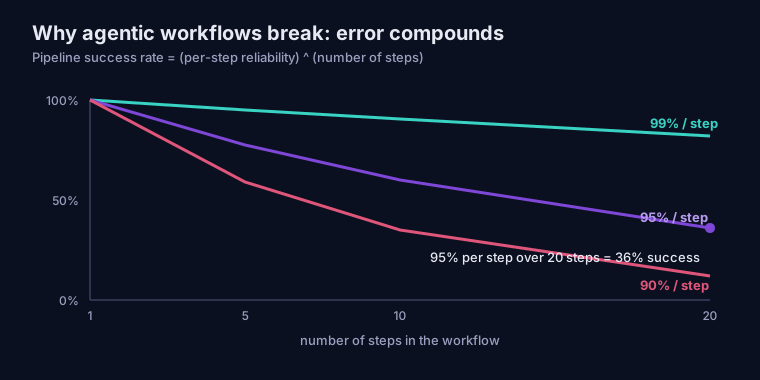
| Per-step reliability | 5 steps | 10 steps | 20 steps |
|---|---|---|---|
| 99% | 95% | 90% | 82% |
| 95% | 77% | 60% | 36% |
| 90% | 59% | 35% | 12% |
This is why an agentic workflow that looks flawless in a notebook degrades once it runs on real inputs. Mutagent’s positioning research keeps surfacing the same pattern: agents that score in the mid-90s in testing settle into the 60 to 70% range in production, and the gap is rarely one dramatic bug. It is a dozen 95%-reliable steps multiplying.
Two structural reasons make it worse than a normal distributed system:
- The coherence illusion. An early wrong step often produces output that looks valid to every step after it. A tool returns stale-but-well-formed data, the model reasons confidently on top of it, and the final answer is wrong while every individual step “passed.”
- Tools lie quietly. A tool call can return HTTP 200 with an error payload, and the workflow proceeds on bad data. This is the same silent-failure pattern that dominates Mutagent’s analysis of agent observability complaints: the system looks healthy while the signal is already gone.
The practical takeaway is a reliability budget. Decide the success rate the workflow needs, then work backward to the per-step reliability and the maximum number of steps that budget allows. If the math does not close, the answer is fewer steps, not more prompting.
When Should You Not Use an Agentic Workflow?
The most reliable agentic workflow is the one you did not build. Before adding an LLM to a step, check whether the step needs one.
- If you can enumerate the input space, use deterministic code. Validation, formatting, routing on a known set of values, and writing to a database are all cheaper, faster, and fully testable without a model.
- If the task is ambiguous but bounded, use a router workflow. Let the model classify, then hand off to deterministic paths. You get flexibility at the entry point and reliability everywhere after it.
- If the path is genuinely open-ended, use an agent, with checkpoints. Reserve runtime autonomy for tasks where the path cannot be known in advance, and put a human approval gate in front of any irreversible action.
The production reality in 2026 is a hybrid pipeline, not a binary choice. The durable rule: the LLM reasons, code executes, and a human approves anything with a large blast radius. Let the model interpret, summarize, draft, and propose. Do not let it approve, pay, provision, or submit without a deterministic check in between.
How Do You Make an Agentic Workflow Observable?
You cannot improve a workflow you cannot see, and a multi-step flow is invisible without instrumentation. Two practices separate teams that ship reliable workflows from teams that ship and pray.
Trace every step as a span. Give each model call, tool call, and hand-off its own timed span under one root span for the request, so a failure is a tree you can replay rather than a single downstream error line. This is the foundation covered in LLM tracing, and it is what makes trajectory evaluation possible at all.
Evaluate the trajectory, not just the output. Score whether the workflow took a sensible path, not only whether the final answer reads well. A model swap makes this non-negotiable: when you change the underlying LLM, output formats and reasoning shift, and a downstream step that parsed the old format can break silently. Without a trajectory baseline to compare against, you cannot tell whether a new model improved the workflow or quietly regressed it.
That is the loop an agentic workflow needs to stay reliable: trace each run, evaluate the path, and gate changes on the evaluation rather than on a glance at a dashboard.
Next Steps
Agentic workflow patterns are the structure; reliability is the engineering. Once your workflow is traced and evaluated, the next layer is keeping it reliable as it changes, which is the job of AI agent observability and, for production agents that take real actions, agent governance.
Mutagent’s autonomous AI Engineer runs that loop across your workflow’s lifecycle: it monitors the trajectory, diagnoses the step that regressed, and proposes the targeted fix, so you spend your reliability budget where it matters. Meet the agents to see the Monitor, Diagnose, Optimize loop applied to a live workflow.
Frequently Asked Questions
What is an agentic workflow?
An agentic workflow is a task completed by chaining several LLM-driven steps, where each step's output feeds the next and the model decides at least part of the path at runtime. It sits between a fixed script, where every step is coded in advance, and a fully open-ended agent that directs its own process. The defining trait is that an LLM, not a developer, makes some of the control-flow decisions, which is what gives the workflow flexibility and also what makes its reliability harder to guarantee.
What is the difference between an agentic workflow and an AI agent?
Anthropic's distinction is the cleanest: a workflow runs LLMs through predefined code paths, while an agent lets the LLM dynamically direct its own process and tool use. In practice it is a spectrum, not a binary. A prompt chain with fixed steps is a workflow; a loop where the model plans, acts, observes, and re-plans until it decides it is done is an agent. Most production systems are a mix: deterministic code for the steps that must be reliable, LLM reasoning for the steps that need judgment.
When should you use an agentic workflow instead of a deterministic one?
Use deterministic code when you can enumerate the inputs and the path is known: it is cheaper, faster, and fully testable. Reach for an agentic workflow when the input is ambiguous or the path varies, for example classifying a free-text request and routing it, or drafting a response that depends on retrieved context. The cost is real: an agentic step adds latency, token spend, and non-determinism. A good rule is to keep the smallest possible agentic core and wrap it in deterministic validation and guardrails.
How do you evaluate an agentic workflow?
Evaluate the trajectory, not just the final answer. A workflow can return a plausible output while taking a wrong path: calling the wrong tool, skipping a step, or recovering from a silent error. Score at three levels: step-level (did this tool get called with a valid schema?), trajectory-level (did the agent take a reasonable path to the goal?), and task-level (did the user's objective get met?). Standard text metrics like ROUGE or accuracy miss most multi-step failures, so trajectory evaluation, often with an LLM-as-judge, is the practical default.
Are agentic workflows reliable enough for production?
They can be, but only if you design for compounding error. A workflow that is 95% reliable at each step succeeds about 36% of the time over 20 steps, because the per-step error rate multiplies. Reliability comes from keeping workflows short, gating each step with validation, tracing every run, and evaluating trajectories before and after deploy. Teams that treat an agentic workflow like a deterministic script, ship it, and watch the dashboard tend to discover the failures in production rather than before.