AI Governance Tools for Autonomous Agents
AI governance tools monitor, audit, and enforce policy on AI. Most govern static models. Learn what changes when you must govern agents that take actions.
AI governance tools help organizations monitor, audit, and enforce policy on AI systems in production. The category is mature for one kind of AI: the machine-learning model, where a system takes an input, returns an output, and a human reviews that output before acting on it. Autonomous agents break that assumption. An agent can call a dozen tools, send an email, update a CRM record, and trigger a downstream process from a single prompt, all before any human sees the result.
That difference is the whole story. This page explains what AI governance tools do, why governing an agent is a different problem from governing a model, and the criteria that actually matter when you choose tooling for agents that take real actions.
What Do AI Governance Tools Do?
The established AI governance market organizes around four jobs, and most platforms you will compare cover some mix of them:
- Discovery. Find where AI is used across the organization, including shadow AI nobody registered.
- Model monitoring. Watch deployed models for drift, bias, and performance decay against a baseline.
- Compliance documentation. Generate the artifacts auditors and regulators ask for: model cards, impact assessments, audit reports.
- Framework mapping. Map controls to the NIST AI Risk Management Framework, the EU AI Act, and ISO/IEC 42001.
These jobs are necessary and they are largely about models and paperwork. The buyer is usually a risk or compliance owner, and the workflow is register the model, assess its risk tier, document it, monitor for drift, re-certify. None of that describes what an autonomous agent does between a user’s prompt and the actions it takes.
Why Is Governing AI Agents Different From Governing Models?
An agent is a different object than a model, with different risks, so the controls that work for one do not transfer to the other. Five properties separate them.
| Property | ML model | Autonomous agent |
|---|---|---|
| Behavior | One input, one output, stable and documentable | Non-deterministic path that varies every run |
| Action | A human reviews the output before acting | The agent acts before any human sees the result |
| Compliance unit | The model’s prediction | The whole execution path |
| Tool use | None, or a fixed pipeline | Tools chosen at runtime, in any order |
| Scope | One model | An orchestrator plus subagents, behaving as a system |
The third row is the one most governance tools miss. A single database read is harmless; a database read followed by an outbound email may be data exfiltration. You cannot assess compliance on individual actions in isolation, because the violation is a property of the path. And when an orchestrator delegates to subagents, an information-barrier breach can belong to the combined path of two agents, neither of which broke a rule on its own.
This is also why model-era controls fall short in specific, testable ways: a model card does not describe an agent’s behavior, drift monitoring does not detect tool misuse, and a compliance report does not capture a decision chain. The documentation is still useful for auditors. It just does not govern the agent.
What Are the Three Layers of Agent Governance?
Governing an agent means acting on its behavior at three points in its lifecycle, not filing a document once. Think of it as a stack: gate before deploy, guard at runtime, and watch after deploy, with production feeding back into the gate.
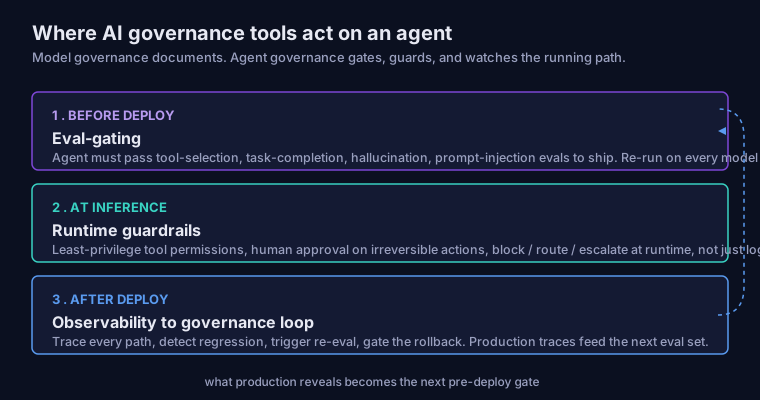
1. Eval-gating, before deploy. Require the agent to pass an evaluation suite before promotion: tool-selection quality, action completion, hallucination rate, prompt-injection resistance. Thresholds act as a release gate, the way test coverage gates a merge. This is the discipline behind eval-driven development, and it is the only objective check that catches a regression introduced by swapping the underlying model.
2. Runtime guardrails, at inference. Documentation does not stop an action; runtime enforcement does. Give the agent least-privilege tool permissions, require human approval for irreversible actions, and enforce policy by blocking, routing, or escalating at runtime rather than only logging after the fact. Passive monitoring tells you what happened; a guardrail prevents what should not.
3. Observability to governance loop, after deploy. Trace every execution path, detect when behavior regresses, trigger a re-evaluation, and gate the rollback on the result. The production traces that surface a new failure become the next case in your eval set. This closes the loop covered in LLM tracing: observability is the evidence, governance is the control that acts on it.
What Governance Frameworks Apply to AI Agents?
The frameworks every governance page cites are real and worth mapping to, but each was written before autonomous agents were a mainstream deployment pattern, so each leaves a gap for agents.
| Framework | What it covers | The gap for agents |
|---|---|---|
| NIST AI RMF 1.0 | Govern, Map, Measure, Manage functions for AI risk | Built for model-level risk, not runtime agent paths |
| EU AI Act | Risk tiering, human oversight, transparency, conformity | Human oversight assumes behavior is known at deploy time |
| ISO/IEC 42001 | A certifiable AI management system, plan-do-check-act | A management system, not real-time control of an agent |
The actionable, agent-specific guidance is moving faster than the formal standards. The OWASP Top 10 for LLM Applications is the most concrete starting point for the agent threat surface: prompt injection, excessive agency, insecure tool use, and the failure modes that matter once an agent can act. Treat the formal frameworks as what you document for auditors, and the OWASP list as what you actually defend against in code.
How Do You Choose AI Governance Tools for Agents?
If your AI is agentic, the standard governance checklist misses the questions that decide whether a tool can actually govern it. Add these five.
| Question to ask a vendor | Why it matters |
|---|---|
| Does it trace execution paths, not just model inputs and outputs? | Agents fail mid-path; a final-output view hides where |
| Does it support eval-gating as a promotion control? | Catches regressions before they reach production |
| Does it enforce at runtime, or only observe and report? | Documentation does not stop a bad action |
| Does it handle multi-agent pipelines with an orchestrator and subagents? | Violations are properties of the combined path |
| Does it give agent metrics (tool selection, action completion), not just model drift? | Drift monitoring does not detect tool misuse |
The honest read on the market: the established platforms are strong on the model lifecycle, compliance workflows, and framework mapping, and most have added an agent inventory recently. The capabilities that are still thin across the board are the runtime and evaluation layers, which is precisely where an agent’s real risk lives. When you evaluate a tool, weight those layers, because they are the ones your model-era governance stack does not already cover.
Next Steps
Governing an agent is the control layer on top of the evidence layer. It depends on tracing every path (LLM tracing), evaluating behavior before and after deploy, and keeping the loop running as the agent and its models change. For the workflow side of that reliability problem, see agentic workflows.
Mutagent’s autonomous AI Engineer runs the eval-and-observe loop continuously: it evaluates the agent against your criteria, traces production paths, and diagnoses the regression when behavior drifts, including after a model swap. Meet the agents to see eval-gating and the observability-to-governance loop in practice.
Frequently Asked Questions
What are AI governance tools?
AI governance tools are software that helps organizations monitor, audit, and enforce policy on AI systems in production. The established category grew up around machine-learning models and covers four things: discovering where AI is used, monitoring models for drift and bias, generating compliance documentation such as model cards and risk assessments, and mapping controls to frameworks like the NIST AI RMF and the EU AI Act. The newer requirement, governing autonomous agents that take actions, needs an additional layer those tools were not built for.
What is the difference between governing AI agents and governing ML models?
A machine-learning model takes an input and returns an output that a human reviews before acting on it, so governance can focus on the model: monitor it for drift, document it, re-certify it. An autonomous agent decides which tools to call and takes actions, sending an email, updating a record, running code, often before any human sees the result. Governing an agent means governing its behavior on a path that changes every run, not a single stable model. The unit of compliance becomes the whole execution path, not one prediction.
What is eval-gating?
Eval-gating is using automated evaluations as a release gate: an agent must pass a suite of evals, covering tool-selection quality, task completion, hallucination rate, and prompt-injection resistance, before it is promoted to production. It works like test-coverage thresholds in CI/CD. The most important time to re-run the gate is when you swap the underlying model, because agent behavior can shift substantially between model versions and a passing gate is the only objective way to tell whether the new model improved or regressed the agent.
What is the difference between AI governance and AI observability?
Observability shows you what an agent did: the traces, tool calls, and outputs from each run. Governance decides what the agent is allowed to do and what happens when it crosses a line: the evals it must pass to ship, the runtime guardrails on its actions, and the policy enforced when behavior regresses. They are complementary. Observability is the evidence layer; governance is the control layer that acts on that evidence. For agents, you cannot do the second without the first.
Does the EU AI Act apply to AI agents?
Yes. The EU AI Act applies to AI systems by risk tier regardless of whether they are agentic, and its human-oversight and transparency obligations cover agents that fall into higher-risk uses. The practical gap is that the Act, like the NIST AI RMF, was written assuming a system's behavior is known at deployment time. Autonomous agents complicate that assumption because their path varies per run, which is why agent governance leans on runtime guardrails and continuous evaluation rather than one-time documentation.