Customer Service Chatbot: What It Takes to Trust One in Production
A customer service chatbot is easy to demo and hard to trust at scale. One wrong policy answer is a liability. How to evaluate one for production reliability.
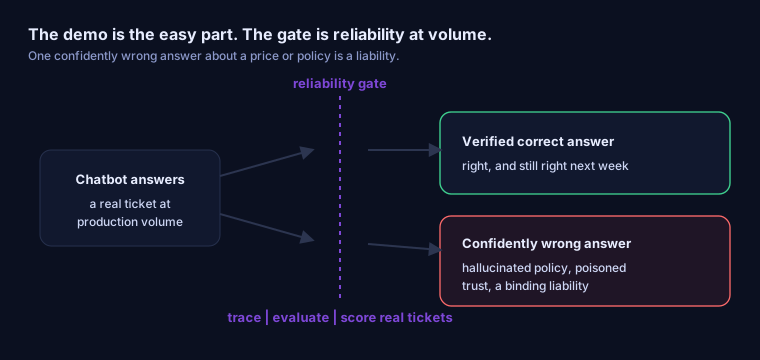
A customer service chatbot is an AI agent that reads a customer’s question, pulls from your knowledge base and systems, and answers or resolves the request across chat, email, and messaging, with the phone channel handled by a voice agent. The category works well enough that the question is no longer whether an agent can handle support. Gartner expects agents to autonomously resolve 80% of common service issues by 2029. The question that decides ROI is whether the agent stays reliable at real ticket volume, because a single confidently wrong answer about a price or a policy is a liability, not a bug.
This page covers where a chatbot actually pays off, when a wrong answer becomes a legal problem, the failure modes that decide production outcomes, how the leading platforms compare, and how to evaluate one for reliability. For the concept behind the category, see AI agent vs chatbot.
What a Customer Service Chatbot Actually Does
Most support agents cover a familiar set of jobs, and they are genuinely useful where the volume is high and the answer is checkable.
| Job | What the agent does |
|---|---|
| Answer FAQs | Read a question, find the policy, reply |
| Track orders | Look up an order, report status |
| Process simple requests | Returns, address changes, subscription updates |
| Triage and route | Classify a ticket, send it to the right queue |
| Assist a human | Draft a reply, summarize a long thread |
The trap is measuring success by deflection, the share of tickets the bot closes without a human. A deflected ticket is not a solved ticket. A chatbot can mark a conversation resolved while the customer walks away unhelped, comes back more frustrated, or quietly churns. Dashboards can look healthy while trust erodes underneath them, because customers rarely say “your bot was wrong.” They just escalate later or leave. Picking which tasks to automate is the easy call. Knowing whether the answers are actually right is the hard one.
Why the Demo Is the Easy Part
A demo answers ten scripted questions perfectly, but a bot that works on day one is just a guess until it meets real traffic. Production means every phrasing, every edge case, and a customer base that is skeptical before the first message.
The sentiment data is blunt. A Gartner survey of 5,728 customers found 64% would prefer that companies did not use AI in their customer service, and 53% would consider switching to a competitor if they learned a company was going to use AI for support. Among their top concerns, alongside the difficulty of reaching a person, was AI providing the wrong answers. The audience is primed to distrust the agent, so a visible mistake costs more than it would in a channel customers chose willingly.
This is the same production gate that stalls agents everywhere. Gartner expects over 40% of agentic AI projects to be canceled by the end of 2027 over cost and inadequate risk controls, and an MIT study widely covered in 2025 found about 95% of enterprise generative AI pilots delivering no measurable return. The ceiling everyone is chasing is real, but only the reliable agents reach it.
When a Wrong Answer Becomes a Liability
The clearest reason reliability is the gate is that a wrong answer can be legally binding. In Moffatt v. Air Canada, the British Columbia Civil Resolution Tribunal held Air Canada liable for wrong information its chatbot gave a customer about bereavement fares, and awarded damages. Air Canada argued the chatbot was a separate legal entity responsible for its own answers. The tribunal rejected that and found the company responsible for everything on its site, whether it came from a static page or a bot.
The brand-trust version of the same failure is just as costly. A DPD support bot was talked into swearing at a customer and writing a poem criticizing its own company in early 2024, and a Chevrolet dealer’s chatbot was coaxed into agreeing to sell a vehicle for a dollar. Each was a viral incident that no deflection dashboard would have flagged. One wrong answer to one customer is an incident. The same wrong answer served thousands of times a day is a systemic problem.
The Four Failure Modes That Decide Production Outcomes
None of the failures that pull a support agent from production are about the use case. They are about the agent being wrong in ways nobody measures.
Hallucinated policy or pricing. The agent invents a refund window, a discount, a warranty term, or a price that does not exist and states it with full confidence. This is the Air Canada failure, and it is the highest severity because the wrong answer looks authoritative.
Deflection theater. The agent fails to recognize it is out of scope and loops the customer, closes the ticket as resolved, or hands off with no context. It traps the high-emotion tickets that most need a human and inflates containment metrics while resolution quietly falls.
Tone and brand-voice failures. The wrong register on a sensitive ticket, a bereavement, a billing dispute, an outage, reads as cold or absurd, and adversarial users can jailbreak the agent into off-brand output. Each one is a screenshot away from going viral.
Silent drift at scale. Accuracy that passed the demo degrades as the ticket mix, the catalog, and the policies change. Without per-ticket scoring against real conversations, a regression ships invisibly and is served at full volume before anyone notices. These are the most-reported classes of agent failure across Mutagent’s community-research corpus of developer pain, and every one traces back to missing evaluation rather than a bad use case.
How the Leading Platforms Compare
The market competes on automation, deflection, resolution rate, and price. Almost none of it competes on how you know the agent is right and stays right. That gap is the whole buying decision.
| Platform | Positions on | Reliability and evaluation posture |
|---|---|---|
| Intercom Fin | Resolution rate, pay-per-resolution pricing | Competes on resolution percentage and price, not continuous correctness scoring |
| Ada | Multi-model reasoning, CX automation, a Measure analytics product | Measure tracks satisfaction and quality, not per-answer correctness against ground truth |
| Sierra | Custom branded agents, outcome-based pricing | Reliability implied through white-glove services, not exposed as buyer-facing evaluation |
| Decagon | Autonomous workflow execution, strong analytics | Analytics are operational dashboards like deflection, not drift detection |
| Zendesk AI | Resolution platform with QA add-ons | QA scores conversation quality and satisfaction, not agent correctness over time |
The consistent pattern is that leaders answer “did the customer rate it well?” The reliability question is different. It asks “was the answer actually right, and is it still right this week?” That distinction is the difference between a satisfaction survey and a working evaluation.
How to Evaluate a Customer Service Chatbot
Once reliability is the gate, evaluation is not a launch checkbox but an ongoing loop, the same one that keeps any production agent trustworthy.
- Observability first. Every conversation the agent handles is traced, so a wrong answer can be found and explained rather than guessed at.
- Continuous evaluation. Answers are scored against real tickets on an ongoing basis through eval-driven optimization, so a hallucinated policy or a drifting response is caught before a customer acts on it.
- Diagnosis and ownership. When quality drops, you can find why, and a named person is accountable for the agent with baseline accuracy captured before launch.
The buyer’s version of this is a short list of questions to ask any vendor. Can I see per-answer correctness, not only satisfaction? How is a hallucinated policy caught before a customer sees it? What is the drift and regression story after launch? A vendor that answers with runtime evidence is selling something you can trust at volume.
Next Steps: Deflection Is Not the Goal
A customer service chatbot earns its place where the volume is high and the answer is checkable. The value shows up on the far side of a reliability gate, and in support that gate is strict, because a wrong answer is a broken promise a customer can hold you to.
Mutagent’s autonomous AI Engineer is built to carry agents across that gate. It traces every conversation, scores answers against real tickets, finds where reliability drops, and proposes validated fixes, so a support agent stays correct as your policies and products change. Meet the autonomous AI Engineer to see how agents earn their place in production, or explore more AI agent use cases.
Frequently Asked Questions
Are AI customer service chatbots reliable?
They are reliable enough to deploy, but only if you keep measuring them, which most teams do not. A modern customer service chatbot handles routine questions well in a demo, then meets inputs in production it never saw, from an edited return policy to a new product line. Accuracy that passed the demo degrades quietly as the ticket mix and the underlying policies change. Reliability is not a property you confirm once at launch. It is a discipline of continuous measurement. The teams whose chatbots stay reliable score answers against real tickets on an ongoing basis and catch regressions before customers do. The teams whose chatbots quietly get worse are usually watching deflection dashboards that look fine while trust erodes underneath them.
Can a chatbot's wrong answer be legally binding?
Yes. In Moffatt v. Air Canada (2024), the British Columbia Civil Resolution Tribunal held Air Canada liable for wrong information its customer service chatbot gave a customer about bereavement fares, and awarded damages. The airline argued the chatbot was a separate entity responsible for its own answers, and the tribunal rejected that, finding the company responsible for everything on its site including what the bot said. The lesson for anyone deploying a chatbot is direct. A confidently wrong answer about a price, a policy, or a refund is not a harmless glitch. It is a statement your company can be held to. That is why catching a wrong answer before a customer acts on it, rather than after, is a reliability requirement and not a nice-to-have.
Will AI replace customer service?
Not wholesale, and the evidence points to a blend rather than a replacement. Analysts expect agents to handle a large share of routine, high-volume questions, and Gartner predicts agentic AI will autonomously resolve 80% of common service issues by 2029. But customer sentiment is cautious. A Gartner survey of 5,728 customers found 64% would prefer companies did not use AI in customer service, with wrong answers a named top concern. The durable pattern is the agent handling repetitive, checkable requests while a person owns the sensitive, ambiguous, and high-emotion cases, plus every escalation. What decides whether that blend works is not how much the agent deflects, but whether its answers are correct and stay correct as your policies and products change.
How is AI used in customer service?
The common deployments are answering frequently asked questions, tracking orders, processing returns and simple account changes, routing and triaging tickets, drafting replies for human agents, and summarizing long conversations. The pattern that works is high-volume, repetitive work with a checkable result, which is why FAQ deflection and order status are the usual first wins. The harder cases are the ones with judgment, emotion, or ambiguity, where a wrong or tone-deaf answer does lasting damage. The deciding factor is rarely which tasks you automate. It is whether you can prove the agent's answers are right and detect when they drift, because a chatbot that deflects a lot of tickets while getting a fraction of them subtly wrong is a liability dressed as a savings.
What is a good deflection rate for a customer service chatbot?
Deflection is the wrong headline number to optimize, because a deflected ticket is not the same as a solved one. A chatbot can close a conversation, mark it resolved, and still leave the customer unhelped, who then comes back angrier or silently churns. Chasing a high containment rate rewards exactly this kind of false resolution. The metric that matters is resolution quality, whether the answer was actually correct and the customer's problem was actually handled, measured by scoring real conversations rather than counting closes. A chatbot that genuinely resolves a smaller share of tickets correctly is worth more than one that deflects a large share into frustration. Optimize for answers you can verify, and let deflection follow from real resolution.