AI Agent vs Chatbot: Answering Is Not the Same as Acting
An AI agent acts; a chatbot answers. Learn the real difference, what each is for, and the new failure modes you take on when an agent starts acting.
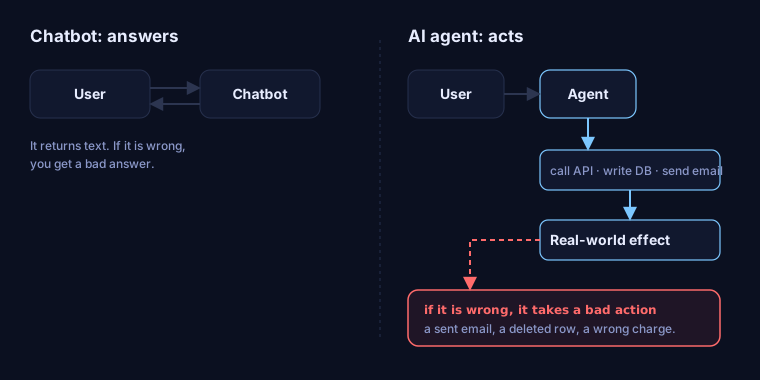
The difference between an AI agent and a chatbot comes down to one word: a chatbot answers, an agent acts. A chatbot takes a message and returns text. An agent takes a goal, plans steps, calls tools, and changes something, a record, an email, an order, before it reports back. Everything else, how smart the conversation feels, which model is under the hood, follows from that one distinction.
This page covers the real difference, what each one is actually for, and the part the vendor comparisons skip: the moment a system starts acting instead of answering, it inherits a whole class of failures a chatbot never had.
What Is the Difference Between an AI Agent and a Chatbot?
A chatbot is a conversational interface. It interprets a message and produces a response, sometimes scripted, sometimes from a language model. The interaction starts and ends with text, and a human reads every output before anything happens.
An AI agent is built on a language model too, but it runs a loop: interpret the goal, plan, call tools, observe the result, and decide the next step, repeating until the task is done. The output is not a sentence, it is an effect on a system.
| Chatbot | AI agent | |
|---|---|---|
| Output | A text answer | An action on a system |
| Control flow | One turn, request and response | A multi-step loop |
| Tools | Usually none | Calls APIs, databases, other agents |
| Human in the path | Reads every reply | Often acts before a human sees it |
| Cost of being wrong | A bad answer you can ignore | A bad action you have to undo |
| Typical example | Support FAQ bot | Coding agent, ops agent, booking agent |
The capability jump is real, and so is the responsibility jump. A chatbot that hallucinates wastes a reader’s time. An agent that hallucinates and then acts on it has already done something.
What Each One Is Good At
Chatbots fit work where the job is to answer or route, and a wrong answer is cheap to catch:
- Answering FAQs and product questions
- First-line support triage and routing
- Information lookup and simple guided flows
AI agents fit work that genuinely requires taking action across systems, where the payoff is doing the task, not describing it:
- Coding work, the most mature agent use case (see coding agents)
- Operations tasks: reconciling records, processing tickets end to end, running multi-step workflows
- Anything where the value is the action completed, not the answer returned
The test is simple: if the goal is satisfied by good text, you want a chatbot. If the goal is only satisfied by something happening, you want an agent, and you take on what comes with it.
The Part Most Comparisons Skip: Acting Means Failing Differently
Every vendor comparison frames the move from chatbot to agent as a straight upgrade. It mostly is. What none of them list is the bill: when a system acts, it fails in ways a chatbot cannot.
A chatbot has one failure mode, a wrong answer, and a human filters it. An agent has a loop, tools, and autonomy, so its failure surface is wider. Across the agent-failure quotes in Mutagent’s community-research corpus (mostly Reddit and Hacker News), the dominant clusters are exactly the ones that only exist once a system acts:
- It loops or hangs (47% of complaints): the agent retries the same broken step instead of finishing, the single most common complaint.
- It hallucinates and acts on it (32%): a chatbot’s wrong fact is read and dismissed; an agent’s wrong fact becomes a tool call.
- It acts without governance (26%): the agent takes actions with no guardrail and no audit trail of what it touched.
- It calls the wrong tool (14%): a class of failure that has no chatbot equivalent at all.
None of these apply to a system that only returns text. They are the cost of crossing from answering to acting, and they are why an agent needs evals, tracing, and review that a chatbot never did.
How Do You Choose Between a Chatbot and an Agent?
Two questions decide it:
- Does the task require an action, or just an answer? If good text satisfies the user, a chatbot is simpler, cheaper, and safer. Reach for an agent only when the job is the action.
- Can you govern the action? If you can put evals, guardrails, and a review gate around what the agent does, an agent is a strong fit. If you cannot, a chatbot plus a human is often the more reliable system than an agent acting unsupervised.
Most real products land on a mix: a conversational layer for the parts that need answers, and an agent invoked only where an action is genuinely required and can be controlled.
How Do You Move From Chatbot to Agent Safely?
The jump from chatbot to agent is a jump in failure surface, so the work is making the agent’s actions observable and verifiable before you trust them:
- Evaluate the actions, not just the replies. A chatbot is judged on answer quality; an agent has to be judged on whether its actions were correct. That needs real evals tied to outcomes.
- Trace every run. When an agent acts wrong, the answer is in the steps it took, which tool, which input, where it diverged. This is the same debugging blindness that drives LLM tracing, and it is unavoidable once a system acts.
- Gate the high-cost actions. Keep a human checkpoint sized to the consequence. An agent’s self-report of success is not enough when the action is irreversible.
This is the discipline Mutagent’s autonomous AI Engineer brings to production agents: it traces a failing run, finds the step at the root of a wrong action, and proposes a validated fix, so the move from answering to acting does not mean flying blind.
Next Steps
Chatbots answer; agents act. The upgrade is worth it when the job needs an action and you can stand behind what the agent does. The teams that get value from agents are the ones that treat the agent’s actions as something to evaluate and trace, with the same rigor a chatbot never required.
Meet the autonomous AI Engineer to see how that works in practice, or keep exploring AI agent use cases.
Frequently Asked Questions
What is the main difference between an AI agent and a chatbot?
A chatbot answers: it takes a message and returns text. An AI agent acts: it takes a goal, plans steps, calls tools (APIs, databases, other systems), and changes something in the real world before it reports back. The difference is not how smart the conversation feels, it is whether the system only talks or actually does.
Is an AI agent just a smarter chatbot?
No. A smarter chatbot still only returns text. An agent crosses into taking actions on your systems, which is a different category of capability and a different category of risk. A chatbot that is wrong gives a bad answer a person can ignore; an agent that is wrong takes a bad action, like sending the wrong email or updating the wrong record.
When should I use a chatbot instead of an AI agent?
Use a chatbot when the job is to answer questions or route a conversation and a wrong answer is low-cost and easy to catch: FAQs, simple support triage, information lookup. Use an agent when the job genuinely requires taking action across systems and you can put real guardrails, evals, and review around those actions. If you cannot govern the actions, a chatbot plus a human is often safer than an under-governed agent.
Why are AI agents harder to make reliable than chatbots?
Because they act. A chatbot has one failure mode, a wrong answer, and a human reads every output. An agent runs a multi-step loop with tool calls, so it can loop on the same failure, take an action on a hallucinated fact, call the wrong tool, or act with no audit trail. Across the agent-failure complaints in Mutagent's community-research corpus, looping or hanging (47%) and undetectable hallucinations (32%) are the two largest clusters, and neither exists for a plain chatbot.
Do AI agents replace chatbots?
Not exactly. Agents absorb the conversational front-end of a chatbot and add the ability to act on it. Many production systems are still better served by a chatbot for the parts that only need answers, with an agent invoked only where an action is genuinely required and can be governed. The right design is usually a mix, not a wholesale replacement.