Prompt Enhancer vs Prompt Optimizer: Only One Can Prove It Helped
Prompt enhancers rewrite your prompt. Optimizers measure whether the rewrite works. Compare free enhancers, OpenAI and Anthropic tools, DSPy, and Mutagent.
A prompt enhancer takes your prompt and returns a rewritten version that follows known best practices. A prompt optimizer runs your prompt against a dataset, scores every output with a metric, and keeps only the changes that measurably beat the baseline. Free web tools, custom GPTs, and the built-in tools from OpenAI and Anthropic sit in the first group. DSPy, Opik, and Mutagent sit in the second. The split matters because an unmeasured rewrite is a guess, and on free-text tasks even the measurement is noisier than most teams expect. This page compares both groups, with numbers.
What Does a Prompt Enhancer Do?
A prompt enhancer performs a one-shot rewrite. You paste a prompt in, a stronger model rewrites it against a checklist of prompt engineering practices, and you get the new version back. The technique behind almost every tool in this class is meta prompting, and OpenAI’s cookbook documents it end to end. Nothing gets executed against your task. Nothing gets scored.
The class is crowded because the mechanism is cheap to build:
- Free web tools that take a prompt and return a cleaner one, sometimes with a short round of clarifying questions first.
- Custom GPTs and browser extensions that do the same rewrite inside ChatGPT or on top of whatever page you are typing into.
- Provider consoles, where OpenAI and Anthropic ship first-party rewriting tools (covered below).
The output is useful for readability. You get role framing, XML or markdown structure, explicit output formats, and step-by-step reasoning instructions. What you do not get is evidence. The rewrite is derived from generic best practices, and the tool has never seen your task fail, so it cannot target the failure. Whether the enhanced prompt performs better on your inputs stays unknown until something measures it.
A quick test shows the ceiling. Paste the same prompt into two different prompt enhancer tools and you get two different rewrites, each confident, each plausible, with no way to rank them. The prompt enhancer cannot break that tie, because breaking ties requires a score.
What Does a Prompt Optimizer Do Differently?
A prompt optimizer needs three inputs before it runs. A dataset of real examples, a metric that scores an output, and a budget. It executes your prompt on the dataset, scores the results, proposes mutations, re-scores them, and accepts a mutation only when the score beats the baseline.
DSPy’s GEPA is the cleanest public reference for the loop. Its documentation states the mechanism plainly, “Examples and their metric results are sent to the reflection LM, which proposes new instructions,” and candidates survive only if they score higher on the training examples (DSPy docs). Opik ships two optimizers of the same shape, HRPO and a GEPA wrapper. Platform products like Mutagent run the loop as a service on top of your traces and eval sets.
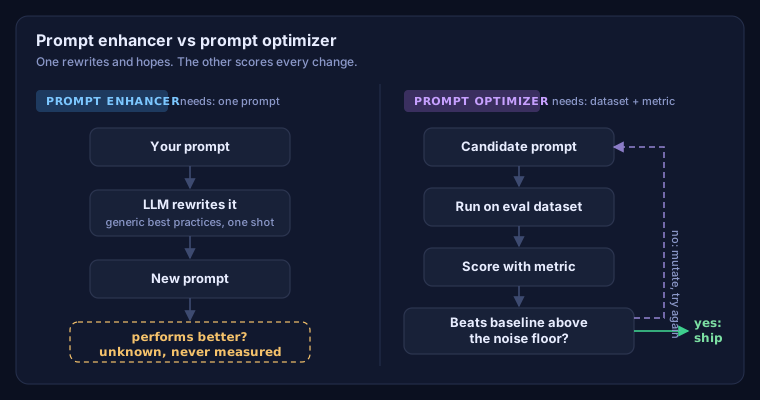
The price of admission explains why enhancers dominate the search results. Most teams have no labeled dataset and no metric on the day they go looking for a better prompt. An enhancer asks for nothing. An optimizer asks for the two assets that take real work to build, and repays that work by turning prompt changes from taste into measurement.
Do OpenAI and Anthropic Have Prompt Enhancers?
Both do, and both tools belong in the enhancer class, whatever their names say.
OpenAI ships a prompt optimizer in its developer dashboard. You open a chat interface, paste a prompt, and it returns a version rewritten to current best practices. A dataset-backed variant inside the Evals platform could fold graded examples and human annotations into the rewrite, but OpenAI is retiring it. Per the same page, Evals becomes read-only on October 31, 2026 and shuts down on November 30, 2026. The searches for an openai prompt enhancer mostly land here, on the cookbook’s meta prompting recipe, or on third-party wrappers.
Anthropic ships a prompt improver in the Claude Console. It runs four documented steps, example identification, a structured redraft, chain-of-thought refinement, and example enhancement. Scoring lives in a separate evaluation tool. The improver itself measures nothing.
ChatGPT is the enhancer most people already have. A chatgpt prompt optimizer in practice means a custom GPT or a plain instruction like “improve this prompt.” Same class, same limit. The model rewrites confidently and never checks the result against your task.
None of this makes the provider tools bad. They encode genuine expertise and they solve the blank-page problem well. They just stop exactly where the hard question starts.
How Do the Prompt Tools Compare?
Features make a poor comparison axis for these tools. What separates them is what each one demands from you, and what it can prove in return.
| Tool | Needs from you | Returns | Proves improvement? | Best fit |
|---|---|---|---|---|
| Free web enhancers | one prompt | rewritten prompt | No | casual and one-off prompts |
| ChatGPT / custom GPTs | one prompt | rewritten prompt | No | quick drafts inside chat |
| OpenAI dashboard optimizer | a prompt | best-practice rewrite | No (Evals variant retires Nov 30, 2026) | teams already on the OpenAI stack |
| Anthropic prompt improver | a prompt template, optional examples | structured chain-of-thought rewrite | No (eval tool is separate) | Claude prompts that need structure |
| DSPy (GEPA, MIPROv2) | dataset + metric + a Python program | optimized instructions | Yes, against your metric | typed multi-step pipelines |
| Opik optimizers (HRPO, GEPA) | dataset + metric | optimized prompt | Gate-dependent, see below | teams already tracing in Opik |
| Mutagent | dataset + metric, or traces to build them | optimized prompt + per-failure diagnosis | Yes, measured | production agent prompts |
Disclosure up front. Mutagent is our product, and the last two rows draw on our own controlled replication of these optimizers. The design, the caveats, and the full results are public in the benchmark write-up, so the claim can be checked rather than believed.
The table also sketches the honest upgrade path. Start with a prompt enhancer while a prompt is young and unmeasured. Once that prompt runs in production, its failures become data, and that data is exactly the dataset an optimizer needs. Few teams need to pick a side forever. They need to know which side of the line their prompt sits on today.
Can You Trust a Reported Improvement?
Before trusting any tool’s uplift claim, measure your evaluation noise. LLM-as-judge metrics are not deterministic, even at temperature zero. Score the same unchanged prompt several times with the same judge on the same dataset and the results disagree. Until you know how wide that spread is, you cannot say whether a reported improvement is real or just the judge landing differently on a re-run.
That spread reframes the tool comparison. In our controlled replication, run on identical inputs, the two continuous-gate optimizers we tested returned the seed prompt essentially unchanged, while a diagnose-first approach produced an improvement that cleared the noise with margin. The exact figures are in the write-up. The point that survives them is simpler: a difference smaller than your judge noise is not evidence, however confidently a tool reports it.
The mechanism behind the gap is structural, and worth knowing whichever tool you pick. An acceptance gate that compares one aggregate score against another has to clear the judge noise in a single step, so it correctly rejects small real improvements along with the noise. The approach that cleared it diagnosed failures per item first, then mutated against those specific failure modes. In fairness, Opik’s own published results show large gains on discrete-label benchmarks such as Arc, where scoring is binary and the noise problem mostly disappears. The lesson is that free-text tasks scored by an LLM judge are a different regime from discrete-label benchmarks, and an uplift claim that ignores judge noise is not evidence.
When Should You Skip the Optimizer?
Skip it more often than the vendors would like. The triage is short:
- One-off or personal prompts. Use a free prompt enhancer or ChatGPT and move on. Measurement infrastructure for a prompt you run twice is wasted effort.
- A production prompt, but no dataset and no metric. Do not optimize yet, you would have no way to accept or reject the result. Start by tracing your runs and versioning prompts, then turn real failures into an eval set. The prompt optimization guide covers that groundwork.
- A production prompt with an eval set. Use an eval-backed optimizer, and hold its claimed uplift against your own measured judge noise before you ship the new prompt.
Prompt work is one stage of keeping an agent reliable, alongside observability and evaluation. Mutagent runs the full loop, diagnosis, optimization, and regression checks, as purpose-built agents you can point at your own traces.
Frequently Asked Questions
What is the difference between a prompt enhancer and a prompt optimizer?
A prompt enhancer rewrites one prompt using best practices, with no measurement of whether the rewrite performs better. A prompt optimizer runs candidate prompts against a dataset, scores each output with a metric, and keeps only changes that beat the baseline score. Enhancers improve readability and structure. Optimizers produce evidence.
Does OpenAI have a prompt optimizer?
Yes, with a caveat. The OpenAI dashboard includes a prompt optimizer that rewrites a prompt according to current best practices, which makes it an enhancer in practice. The dataset-backed optimizer inside the Evals platform is being retired. It becomes read-only on October 31, 2026 and shuts down on November 30, 2026.
Can ChatGPT optimize prompts?
ChatGPT can rewrite prompts, either through a custom GPT such as the popular Prompt Enhancer GPTs or by asking the model directly to improve your prompt. That counts as enhancement. ChatGPT never runs the new prompt against your task or scores the outputs, so it cannot tell you whether the rewrite performed better.
Are free prompt enhancers worth using?
For one-off prompts and personal use, yes. A free prompt enhancer adds structure, role framing, and clearer instructions in seconds, and those changes usually help. For a production prompt the answer is no, because the rewrite ships unverified. You would be deploying a change with zero evidence it improved anything.
How do you know if an optimized prompt is better?
Score both prompts on the same fixed dataset with the same metric, then compare the delta against your evaluation noise. LLM judges are non-deterministic even at temperature zero, so re-scoring the same prompt returns different numbers. Any claimed uplift smaller than that spread is indistinguishable from re-evaluation noise.