AI Agent Design Patterns (and the Way Each One Breaks in Production)
The core AI agent patterns, what each one does, and the specific way each fails in production, with the reliability control that keeps it working.
AI agent patterns are the reusable shapes for wiring a language model into a system that takes actions: prompt chaining, routing, reflection, tool use, orchestrator-workers, multi-agent collaboration, and a handful of others. Every guide lists them and tells you when to reach for each. Almost none tells you the part that matters once you ship: each pattern is a reliability bet, and each one fails in a specific, predictable way.
This page covers the canonical patterns, and for each one, the production failure signature and the control that keeps it working. The framing follows the split the field has settled on, from Anthropic’s “Building Effective Agents” and Andrew Ng’s four agentic patterns.
What Is the Difference Between a Workflow and an Agent?
Before the patterns, the one boundary they all sit on. In a workflow, your code decides what runs next and the model fills in the steps. In an agent, the model itself decides at runtime which tool to call, whether to loop, and when the task is done.
That single difference predicts how each pattern fails. Workflows are constrained, so they fail in fewer and more legible ways. Agents are open-ended, so they introduce loops, goal drift, and coordination failures that a fixed code path never has. The most reliable production systems are usually workflows with one or two agentic steps, rather than agents left to run the whole loop on their own.
This is also why “the model is not good enough” is the wrong first diagnosis. As one practitioner put it in Mutagent’s community-research corpus of 7,797 developer pain quotes:
“80% of agent issues are architecture (tool definitions too vague, exit conditions too loose, retry logic missing), not model capability. The hardest part is spec’ing the problem, not the LLM.” — r/AI_Agents
The patterns below are the architecture. Picking the right one, and adding the control it needs, is most of the reliability work.
The Core Agentic Design Patterns (and How Each One Fails)
Here is the canonical set in one view: what each pattern does, the way it breaks in production, and the control that makes it dependable.
| Pattern | What it does | Production failure | Reliability control |
|---|---|---|---|
| Prompt chaining | Pass output of step N into step N+1 | Errors carry forward silently; step N+1 acts on corrupted input with no flag | Validation gate between steps; stop on failed check |
| Routing | Classify the input, send it to a specialized path | Misclassification is a single point of failure; wrong path answers confidently | Confidence threshold plus a fallback path for low-confidence routes |
| Parallelization | Fan a task across branches, then merge | Partial branch failure left unhandled; cost multiplies per branch | Explicit per-branch failure policy; merge logic that tolerates missing inputs |
| Orchestrator-workers | Orchestrator splits work, dispatches to workers | Orchestrator loses the goal or over-decomposes the task | Anchor the goal in context; validate the plan before dispatch |
| Evaluator-optimizer | A generator and a critic loop until “good” | Loop never converges; ambiguous criteria cause oscillation | Hard iteration cap; criteria that are externally verifiable |
| Reflection | Model critiques and revises its own output | Self-critique reinforces the error and sounds more confident | Use a separate model as judge; exit on a measurable condition |
| Tool use | Model calls functions or APIs | Tool returns success on an error payload; the model proceeds on bad data | Validate tool output; branch on explicit error types; circuit-break |
| Planning / ReAct | Model decomposes a goal and acts step by step | Plan drifts from the goal across reasonable-looking steps | Tier permissions by reversibility; human gate on irreversible actions |
| Multi-agent | Specialized agents coordinate on one task | No shared state; one bad handoff corrupts everything downstream | Checkpoint validation at every handoff; a shared trajectory log |
The next sections expand the patterns where the failure mode is least obvious and most expensive.
Tool Use: When “Success” Is a Lie
Tool use is the pattern that turns a chatbot into an agent, and the one with the quietest failure mode. The ReAct pattern (reason, then act) is its canonical loop, and framework helpers like LangGraph’s create_react_agent ship a ready-made ReAct agent so you rarely write the loop by hand. The model calls a function, the function returns, and the model treats the return as ground truth. The problem is that a return is not the same as a success.
“Agent reads
status: \"ok\"off an API call, marks the step complete, downstream batch reconciliation surfaces the actual failure 30 minutes later.” — r/aiagents
An HTTP 200 with an error in the body, a partial result, an empty list that should have had rows: the model reads the shape, not the meaning, and continues. Tool-calling failures are one of the most common clusters in Mutagent’s corpus, second only to agents that loop or hang. The control is to validate tool output against what the next step actually needs, give the model explicit error types it can branch on rather than a generic string, and wrap every external call in a circuit breaker so a degraded dependency fails fast instead of feeding bad data forward. How you shape those tool contracts is its own discipline, covered in agent API design.
Reflection and Evaluator-Optimizer: Loops That Never End
Reflection and its cousin evaluator-optimizer are the patterns teams add to raise quality, and the ones most likely to burn tokens for no gain. The model generates, critiques its own work, and revises. In theory the output converges. In practice two things go wrong: the loop spins to its maximum without ever reaching “good enough,” and self-critique reinforces the original mistake while making it sound more confident.
The fix is structural, not a better prompt. Cap the iterations hard. Make the evaluation criterion externally verifiable, so “good” is a check the system can run rather than a vibe the model reports. And where it matters, use a different model as the judge: a model grading its own output shares its own blind spots.
Multi-Agent: One Bad Handoff Corrupts the Run
Multi-agent collaboration is the pattern people reach for too early. The appeal is obvious, split a hard job across specialists, but the coordination cost is real and the failure mode is brutal: there is no shared state, so one bad handoff poisons everything downstream, and you cannot simply retry.
“You cannot just retry because downstream agents have already consumed the output. I ended up building checkpoint validation between every handoff.” — r/aiagents
Coordination failures are a distinct and growing cluster in the corpus, and the recurring lesson is that the model is rarely the cause. Another team running customer-support agents found “the deciding factor wasn’t the model, the framework, or even the prompts, it was grounding” the agents in shared context. The controls are checkpoint validation at every handoff, a shared trajectory log so a failure is traceable to the step that caused it, and a simple test before you adopt the pattern at all: use multi-agent only when the roles genuinely cannot share one context window.
Why Do Multi-Step Agent Patterns Fail So Often?
Every multi-step pattern inherits one piece of math, and it is the reason controls are not optional. End-to-end success is per-step accuracy raised to the number of steps. A step that is right 95% of the time gives you a 60% success rate across ten steps. Drop to 85% per step and ten steps succeed only about 20% of the time.
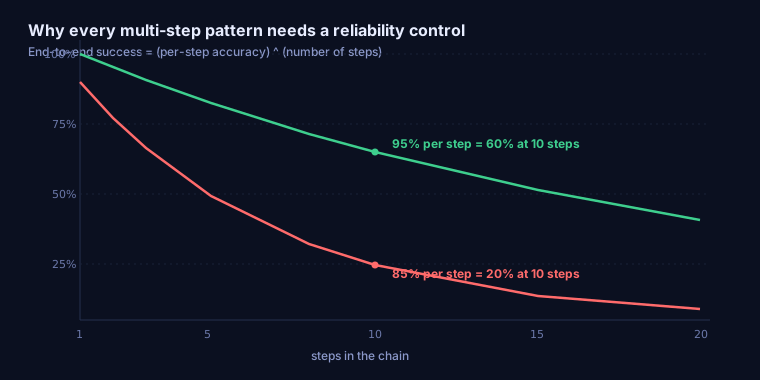
This is why “it works in the demo” and “it works in production” are different claims. A demo is a short chain on a friendly input. Production is a longer chain on inputs you did not anticipate, and the curve is unforgiving. Each control in the table above, validation gates, iteration caps, fallback paths, exists to push per-step accuracy back up or to cut the number of steps, because both move you up that curve.
Which AI Agent Pattern Should You Start With?
The pattern catalog invites over-building. The reliable move is to start with the least machinery that solves the task and add patterns only when a real failure demands one.
- Start with tool use plus one workflow. Prompt chaining or routing handles a surprising share of real tasks, and both are far easier to debug than an autonomous loop.
- Add reflection only when quality is measurable. If you cannot write the check the evaluator runs, reflection will oscillate instead of converge.
- Add planning only when steps cannot be pre-written. A fixed sequence beats a model-generated plan whenever you actually know the sequence.
- Add multi-agent last. Reach for it only when roles cannot share a context window, not because splitting the job feels cleaner.
- Add bounded execution and trace logging before anything ships. A hard cap on loops and a recorded trajectory are the two controls every pattern needs, regardless of which you picked.
Next Steps: Patterns Are a Bet, Reliability Is the Hedge
A pattern decides how your agent is shaped. The control attached to it decides whether the shape survives contact with production. The catalog is the easy half; choosing the smallest pattern that works and instrumenting its failure mode is the half that keeps the system up.
That instrumentation is where the build hub meets observability. You cannot cap a loop you cannot see, validate a handoff you do not trace, or fix a routing error you never recorded, which is why LLM tracing is the foundation under every control above.
Mutagent’s autonomous AI Engineer runs that loop for you: it watches the traces each pattern produces, finds the step where reliability dropped, and proposes the targeted fix, the validation gate, the iteration cap, the tool-contract change, before it reaches your users. Meet the autonomous AI Engineer to see how patterns get hardened in production.
Frequently Asked Questions
What are the main AI agent design patterns?
The canonical set has two layers. Workflow patterns, where your code controls the steps: prompt chaining, routing, parallelization, orchestrator-workers, and evaluator-optimizer. Agent patterns, where the model decides the steps at runtime: reflection, tool use, planning or ReAct, and multi-agent collaboration. The split comes from Anthropic's workflow-versus-agent distinction and Andrew Ng's four agentic patterns. Workflows are more predictable; agents are more flexible and fail in more ways.
What is the difference between a workflow and an agent?
In a workflow, predefined code decides what runs next; the model fills in steps but does not choose the path. In an agent, the model decides at runtime which tool to call, whether to loop, and when it is done. Workflows trade flexibility for predictability, so they fail less often and more legibly. Agents handle open-ended tasks but introduce loop, coordination, and goal-drift failures that workflows do not have. Most production systems are workflows with one or two agentic steps, rather than agents left to run the whole loop on their own.
Why do AI agents fail in production even when the pattern is correct?
Because the pattern is a reliability bet, not a guarantee. Each pattern adds a specific failure mode: chains carry errors forward silently, routers misclassify with no fallback, reflection loops never converge, tool calls return success on an error payload, and multi-step plans drift from the goal. Per-step accuracy also compounds: at 85% accuracy per step, a 10-step chain succeeds end to end only about 20% of the time. A better model does not resolve these failures; the fix is a control attached to each pattern, such as validation gates, iteration caps, and bounded execution.
Which AI agent pattern should I start with?
Start with the simplest pattern that solves the task. Use tool use plus a single workflow such as prompt chaining or routing before reaching for autonomous agents. Add reflection only when output quality is measurable, planning only when steps cannot be written in advance, and multi-agent only when roles genuinely cannot share one context window. Add bounded execution and trace logging before any pattern ships, regardless of which one you pick.
What is the orchestrator-workers pattern?
An orchestrator model breaks a task into subtasks, dispatches each to a worker model, and combines the results. It suits tasks where the subtasks are not known in advance, such as researching a question across several sources. The common production failure is the orchestrator losing the original goal mid-run or over-decomposing a simple task into too many subtasks. The control is to anchor the goal in the orchestrator's context and validate its plan before any worker is dispatched.