Meet the Agentic AI Engineer
Building agents by hand keeps you inside the loop. Vibe-automating it with a coding agent or buying an observability platform does not get you out. The Agentic AI Engineer is the Agent Development Lifecycle, run agentic.
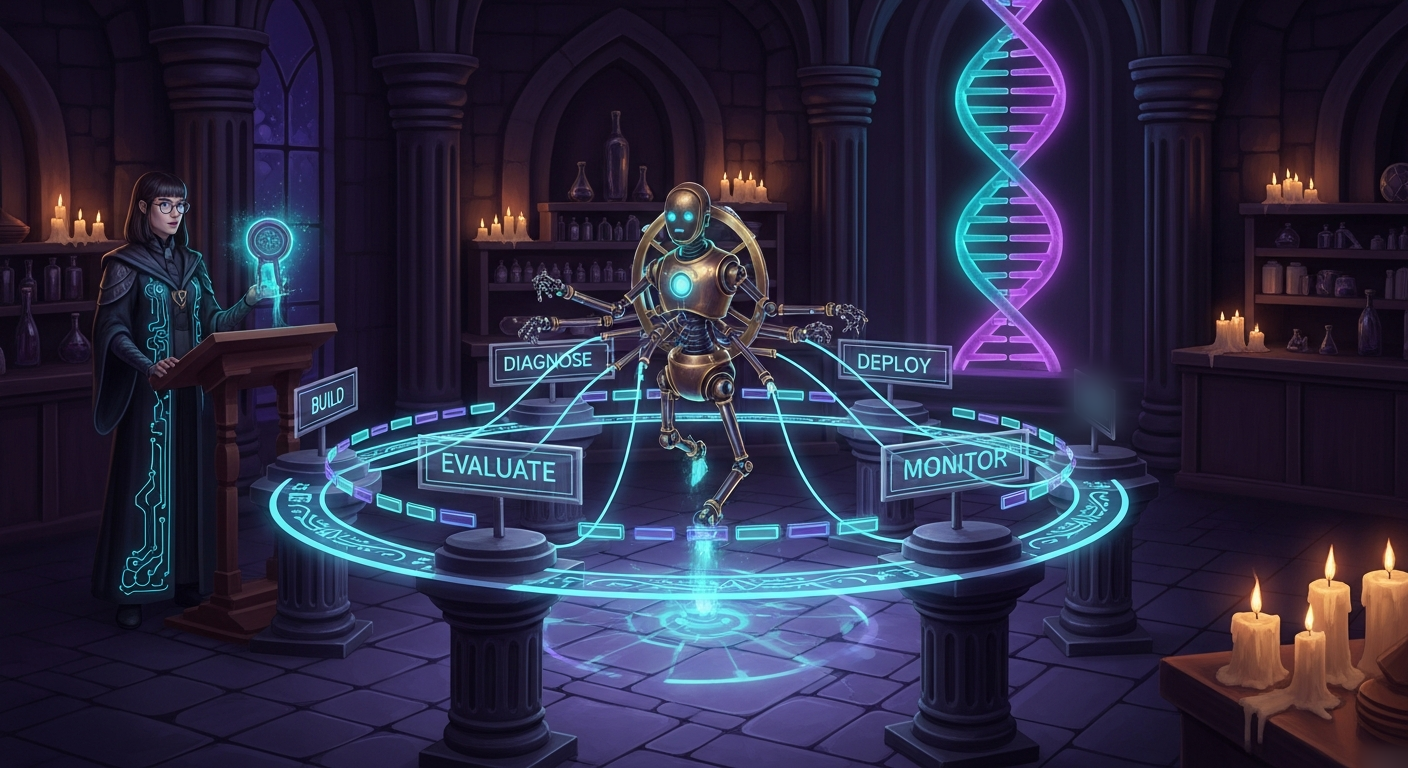
Meet the Agentic AI Engineer
Last year the work was prompt engineering. This year the real unit is the loop, not the prompt.
An AI agent is never done. It ships, it meets reality, it breaks in a new way, you fix it, reality moves again. That cycle has a name now: the Agent Development Lifecycle. Five stages, run as one loop. Offline you build and sharpen. Online it runs and production feeds the next pass. Get the loop right and the prompts take care of themselves.
Today most teams run that loop by hand. And by hand, you are inside it. There are two ways people try to escape, and both leave you exactly where you started.
Camp one: vibe-automate it with a coding agent
You change a prompt, the coding agent writes the change, you generate a few outputs. Then a human sits and reads the traces to decide if it actually got better. The coding agent writes. You still grade. It is fast to type and slow to know. Nothing compounds, because the judgment never leaves your head.
Camp two: buy an observability platform
Now you have dashboards. Traces, spans, alerts, a wall of charts. They tell you something broke. They never tell you why, and they never fix it. Detection got cheap. Diagnosis didn’t. You are still the one scrolling logs at 9pm.
Both camps keep the bottleneck in the same place: you, reading traces.
Step out of the loop and the number that moves is throughput, not quality. How many improvement cycles fit in the same week? By hand, maybe a dozen. Run the loop agentically and the same window fills in: north of two hundred. Roughly twenty times the iterations, and every one compounds on the last. That is the whole game.
The third path: run the lifecycle agentic
The Agentic AI Engineer is the Agent Development Lifecycle, run agentic. One orchestrator drives all five stages end to end. Build the agent from a signed spec. Evaluate it against a dataset of real cases and binary criteria that roll up into one score the loop can chase. Deploy it pinned. Monitor what production is actually doing. Diagnose failing traces by clustering them to root cause, where each cause becomes a new eval the system absorbs. The loop turns until a candidate clears the bar and beats the live version, and only then does it ship. You stop being the loop. You start operating it. You design the system. The agents maintain it.
∞Mutagent Use CaseImprove Chains every agent into one orchestrator that runs the whole lifecycle end-to-end. You set the goal and stay the human in the loop; it runs the steps. IN a work item (feature or incident) OUT validated PRs · agent + skill updates


 Explore
Where it runs
evidence in
 Langfuse
 OpenTelemetry
 Datadog
 LangSmith
 Braintrust
 SigNoz
 Claude Code
 Codex
Codex Cursor
 Pi
Pi Hermes
 Orchestratorconducts the lifecycle — one agent per stage*specagent · WIP*buildagent · WIP*evalEvaluatorRESEARCH PREVIEW*shipagent · WIP*monitoragent · WIP*diagnoseDiagnosticsRESEARCH PREVIEW*optimizeagent · WIP
where it writes
 GitHubClaude CodeCodexCursor
 Mastra
 DeepAgentsClaude
 Vercel
new traces
TODAY · RUNS LOCALLY · EMBEDDED IN HARNESSFUTURE · CLOUD PLATFORMIt installs as agents inside the coding agent you already use, and it runs locally. Your traces and your code never leave your machine. It reads from the sources you already have, Langfuse, OpenTelemetry, Datadog, LangSmith. It writes to the targets you already ship to, GitHub, your coding agents, your frameworks. The targets run in production and generate the next round of traces, the monitor scans them, and the orchestrator runs the loop again.
Two of these agents are real today. The Evaluator and Diagnostics are in research preview, running for real users right now. The rest are in progress. The future is a hosted platform, managed agents as a service, for the teams that want it fully run.
Stop debugging. Start evolving.
Reliable agents come from one thing: a loop that never stops, run fast enough to compound.
If you want to feel the difference, start at the stage that owns your worst week. This week we put the first one in your hands. The Evaluator ships, the stage that turns “does this feel better” into a number the loop can chase. Burak is previewing it live on Friday. Tell me which stage of your loop eats the most time, and that is the one I want to hear about.