Karpathy on Agents: Why Production Optimization Will Define the Decade
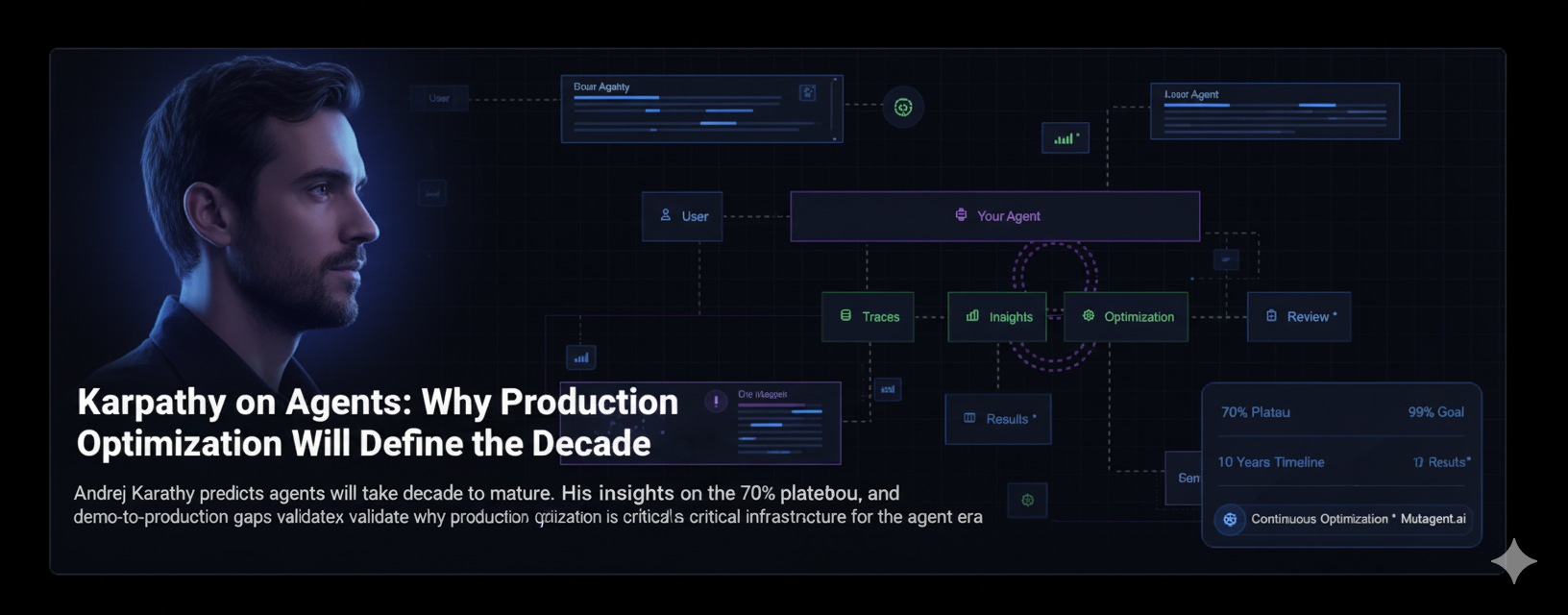
Andrej Karpathy predicts agents will take a decade to mature. His insights on the 70% plateau, RL limitations, and demo-to-production gaps validate why production optimization is critical infrastructure for the agent era.
Karpathy on Agents: Why Production Optimization Will Define the Decade
When Andrej Karpathy declared “It’s the decade of agents, not the year” in his recent Dwarkesh Podcast interview, he wasn’t just correcting industry hype—he was revealing the fundamental infrastructure challenge that will determine which organizations succeed in the agent era.
Karpathy’s insights, drawn from nearly two decades in AI and five years leading Tesla’s self-driving program, paint a clear picture: agents will mature over a decade-long journey marked by predictable plateaus, systematic bottlenecks, and a critical gap between demo performance and production reality. For organizations deploying AI agents today, this timeline isn’t a delay—it’s a roadmap that validates why production optimization infrastructure is essential, not optional.
The organizations that understand this reality and invest in systematic optimization capabilities now will compound their advantages as agents evolve. Those that wait for “perfect” agents will find themselves years behind when the technology matures. Here’s how Karpathy’s insights map directly to the production optimization challenges Mutagent solves.
The Decade Timeline: Why Production Optimization Matters More Than Ever
Karpathy’s decade prediction stems from a sober assessment of the bottlenecks preventing agents from becoming truly autonomous. “They don’t have enough intelligence, they’re not multimodal enough, they can’t do computer use and all this stuff,” he explains. “They don’t do a lot of the things you’ve alluded to earlier. They don’t have continual learning. You can’t just tell them something and they’ll remember it. They’re cognitively lacking and it’s just not working.”
This isn’t pessimism—it’s engineering reality. Karpathy’s timeline reflects the systematic work required to address continual learning, multimodality, and cognitive limitations that prevent agents from operating as true autonomous workers. The key insight: these aren’t problems that get solved once and disappear. They require ongoing optimization throughout the entire maturation cycle.
How Mutagent addresses this challenge: While we can’t solve continual learning or multimodality at the model level, we can optimize how agents use their current capabilities in production. Mutagent’s trace analysis identifies when agents lack context for specific decisions, automatically generates targeted context injections, and creates learning opportunities from every production interaction. This bridges the gap between current agent capabilities and production requirements, making the decade-long journey more productive at every stage.
For organizations deploying agents today, this timeline has profound implications. If agents will take a decade to mature, production optimization infrastructure isn’t a nice-to-have—it’s critical infrastructure for the entire journey. Teams that build systematic optimization capabilities now will compound their advantages as agents evolve. Those that wait for “perfect” agents will find themselves years behind when the technology matures.
The 70% Plateau: The Gap Between “Working” and “Excellent”
Karpathy identifies a specific performance pattern that mirrors what we see across production deployments: agents work “mostly” but get stuck at around 70% effectiveness. “When you’re talking about an agent, or what the labs have in mind and maybe what I have in mind as well, you should think of it almost like an employee or an intern that you would hire to work with you,” he explains. “Currently, of course they can’t. What would it take for them to be able to do that? Why don’t you do it today? The reason you don’t do it today is because they just don’t work.”
This 70% plateau represents the gap between demo success and production reality—exactly the challenge Mutagent addresses. In controlled environments, agents demonstrate impressive capabilities. In production, they handle common cases well but stumble on edge cases, miss critical context, and make systematic errors that compound over time.
How Mutagent breaks through the plateau: Our automated trace analysis processes millions of production interactions to identify the specific failure patterns keeping your agents at 70%. We detect context gaps where agents have the right tools but lack critical information, tool selection biases in multi-step workflows, and hallucination triggers in edge cases. Instead of manual debugging, Mutagent automatically generates targeted optimizations—refined prompts, context injections, and tool selection improvements—that systematically address each failure mode. Early customers see 23% accuracy improvements and 41% reductions in hallucinations within weeks, not months.
The plateau isn’t a model limitation—it’s an optimization challenge. Agents have the capability but lack the systematic approach to bridge the gap from “working” to “excellent.” This requires production optimization infrastructure that can identify failure patterns, generate targeted improvements, and validate changes against real-world usage patterns.
Why RL is “Terrible” - And What It Means for Agent Optimization
Karpathy’s critique of reinforcement learning reveals a fundamental limitation in how we currently optimize agents. “Reinforcement learning is terrible,” he states bluntly. “It just so happens that everything that we had before it is much worse because previously we were just imitating people, so it has all these issues.”
His analysis centers on what he calls “sucking supervision through a straw”—the process where RL upweights entire trajectories based on a single final reward signal. “You’ve done all this work only to find, at the end, you get a single number of like, ‘Oh, you did correct.’ Based on that, you weigh that entire trajectory as like, upweight or downweight.”
This approach fails because it assumes every action in a successful trajectory was correct, when in reality, agents often stumble through wrong approaches before finding the right solution. “You may have gone down the wrong alleys until you arrived at the right solution,” Karpathy explains. “Every single one of those incorrect things you did, as long as you got to the correct solution, will be upweighted as, ‘Do more of this.’ It’s terrible. It’s noise.”
Humans don’t learn this way. When we solve a problem, we review our approach, identify what worked versus what didn’t, and adjust our strategy accordingly. This granular feedback is exactly what trace-based optimization provides—identifying specific failure points in agent reasoning chains rather than just final outcomes.
How Mutagent solves the RL problem: Instead of upweighting entire trajectories based on final outcomes, Mutagent analyzes every step in the agent’s reasoning chain. We identify exactly where agents make wrong decisions, what context they were missing, and which tool selections led to failures. This granular analysis enables targeted improvements—refined prompts for specific decision points, context injections for missing information, and tool selection optimizations for edge cases. Rather than “sucking supervision through a straw,” we provide rich, actionable feedback that improves agent performance systematically.
The Model Collapse Problem: Why Real Production Data Matters
Karpathy’s discussion of model collapse reveals why synthetic data generation often fails for agent optimization. “These models, when you boot them up and they have zero tokens in the window, they’re always restarting from scratch where they were,” he explains. “Any individual sample will look okay, but the distribution of it is quite terrible.”
The problem emerges when models train on their own outputs. “All of the samples you get from models are silently collapsed,” Karpathy notes. “Silently—it is not obvious if you look at any individual example of it—they occupy a very tiny manifold of the possible space of thoughts about content.” He illustrates this with a simple example: “If you go to ChatGPT and ask it, ‘Tell me a joke.’ It only has like three jokes. It’s not giving you the whole breadth of possible jokes. It knows like three jokes.”
This collapse validates why Mutagent focuses on real production traces rather than synthetic data generation. Production data contains the complexity, variety, and entropy needed for genuine optimization. Every user interaction, every edge case, every failure mode represents real-world complexity that synthetic generation can’t replicate.
How Mutagent leverages real production data: Our trace analysis engine processes millions of actual user interactions, not synthetic examples. This real-world data contains the edge cases, failure modes, and complexity patterns that synthetic generation misses. We identify genuine failure patterns—like the adversarial examples Karpathy describes—and create optimizations that work against real production challenges, not artificial test cases. This approach ensures that every optimization we generate addresses actual user problems, not theoretical scenarios.
The implications extend to optimization strategies. When Karpathy describes adversarial examples breaking LLM judges—cases where nonsensical responses like “dhdhdhdh” receive perfect scores—he’s highlighting why process-based supervision requires real production data to identify and prevent these failure modes.
The Demo-to-Production Gap: Lessons from Self-Driving
Karpathy’s five years at Tesla provide crucial insights into the demo-to-production gap that agents face today. “When I was joining Tesla, I had a very early demo of Waymo. It basically gave me a perfect drive in 2014 or something like that, so a perfect Waymo drive a decade ago,” he recalls. “I thought it was very close and then it still took a long time.”
The gap between demo and production follows predictable patterns. “For some kinds of tasks and jobs and so on, there’s a very large demo-to-product gap where the demo is very easy, but the product is very hard,” Karpathy explains. “It’s especially the case in cases like self-driving where the cost of failure is too high.”
The solution isn’t better demos—it’s systematic optimization through what Karpathy calls the “march of nines.” “Every single nine is a constant amount of work. Every single nine is the same amount of work. When you get a demo and something works 90% of the time, that’s just the first nine. Then you need the second nine, a third nine, a fourth nine, a fifth nine.”
This march requires production optimization infrastructure that can systematically improve performance through each nine. “Demos are encouraging. It’s still a huge amount of work to do,” Karpathy concludes. For agents, this means building optimization capabilities that can handle the decade-long journey from 70% to 99% effectiveness.
How Mutagent enables the march of nines: Our continuous optimization loop operates at production scale, processing every interaction to identify improvement opportunities. Instead of manual analysis that can’t keep pace with new failure patterns, Mutagent automatically detects when agents hit new plateaus and generates targeted optimizations for each nine. We validate every improvement against historical production data before deployment, ensuring that each step forward doesn’t introduce regressions. This systematic approach transforms the “huge amount of work” into automated, continuous improvement that compounds over time.
03Mutagent Use CaseImprove Runs the diagnose, mutate, evaluate loop and ships verified fixes, each scoped to a root cause and validated on a held-out slice. IN root cause · eval suite OUT verified fix · before/after scorecard


 Explore
Coding Agents Reality Check: What “Automation” Actually Looks Like Today
Karpathy’s honest assessment of coding agents provides crucial context for realistic expectations. “I would say there are three major classes of how people interact with code right now,” he explains. “Some people completely reject all of LLMs and they are just writing by scratch. This is probably not the right thing to do anymore.”
The middle ground—using autocomplete while maintaining architectural control—represents the current sweet spot. “You still write a lot of things from scratch, but you use the autocomplete that’s available now from these models,” Karpathy describes. “Most of the time it’s correct, sometimes it’s not, and you edit it. But you’re still very much the architect of what you’re writing.”
Full automation remains limited. “The agents work in very specific settings, and I would use them in specific settings,” Karpathy notes. “They’re pretty good, for example, if you’re doing boilerplate stuff. Boilerplate code that’s just copy-paste stuff, they’re very good at that.” But for novel architectural decisions, “the models have so many cognitive deficits.”
This realistic assessment validates why production optimization tools must work with current capabilities, not assumed future capabilities. The goal isn’t to wait for perfect agents—it’s to optimize the agents we have today while building infrastructure for their evolution.
How Mutagent works with current agent capabilities: We don’t wait for perfect agents—we optimize what you have today. Whether your agents are handling customer service, code generation, or data analysis, Mutagent analyzes their actual production performance and generates improvements that work with their current limitations. Our trace analysis identifies when agents struggle with novel scenarios, automatically generates context and prompt improvements, and creates fallback strategies for edge cases. This approach maximizes the value of current agent deployments while building the optimization infrastructure needed for future improvements.
The Path Forward: What Organizations Should Do Now
Karpathy’s insights synthesize into clear guidance for organizations deploying agents today:
Accept the decade timeline. Build optimization infrastructure now rather than waiting for perfect agents. The organizations that invest in systematic optimization capabilities today will compound their advantages as agents mature.
Focus on production data, not synthetic generation. Real traces contain the complexity and entropy needed for genuine optimization. Synthetic data generation often produces collapsed distributions that miss the edge cases and failure modes that matter most.
Expect plateaus and plan for them. The 70% plateau isn’t a bug—it’s a predictable phase in agent maturation. Systematic optimization beats manual debugging at every stage.
Measure progress in nines. Each improvement from 70% to 80% to 90% requires different strategies and infrastructure. The march of nines is constant work that requires production optimization capabilities.
Work with current capabilities. Don’t wait for perfect agents—optimize what you have today while building infrastructure for tomorrow’s improvements.
The Infrastructure Imperative
Karpathy’s decade timeline reveals a fundamental truth: agent maturation is an infrastructure challenge, not just a model capability challenge. Organizations need production optimization infrastructure that can:
- Analyze millions of production traces to identify systematic failure patterns
- Generate targeted improvements based on real-world usage data
- Validate changes against historical production data before deployment
- Continuously optimize performance through each nine of the maturation journey
Mutagent provides this infrastructure today. Our platform processes your existing trace data—from Langfuse, OpenTelemetry, or custom solutions—and transforms it into systematic optimizations. We don’t require new infrastructure or data collection; we work with what you already have to generate the improvements that break through the 70% plateau.
This infrastructure isn’t optional—it’s essential for the decade-long journey from demo success to production excellence. Organizations that build these capabilities now will define the agent era. Those that wait will find themselves years behind when the technology matures.
The decade of agents isn’t a delay—it’s an opportunity. The organizations that invest in production optimization infrastructure today will compound their advantages as agents evolve from 70% to 99% effectiveness. The question isn’t whether agents will mature—it’s whether your organization will be ready when they do.
Ready to build the infrastructure for the agent decade? Mutagent transforms your production traces into continuous optimizations that bridge the gap from demo success to production excellence. Start optimizing today or explore our production optimization case studies to see how we’re helping organizations break through the 70% plateau.
Ready to build the infrastructure for the agent decade? Try Mutagent today | Learn about our production optimization approach