Plan agents following industry best practices using your SOPs, historic data and API surface
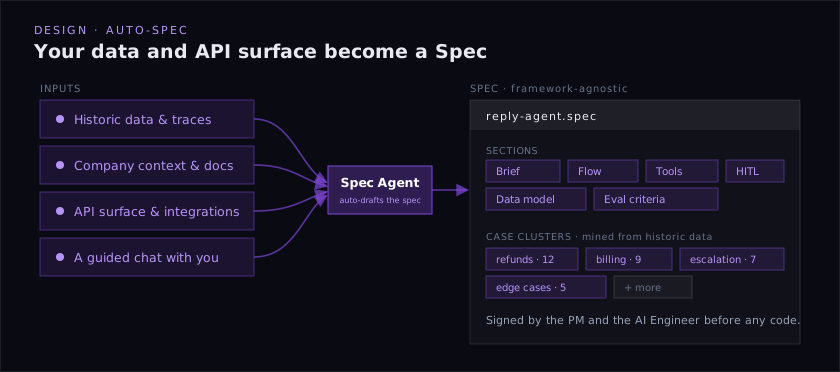
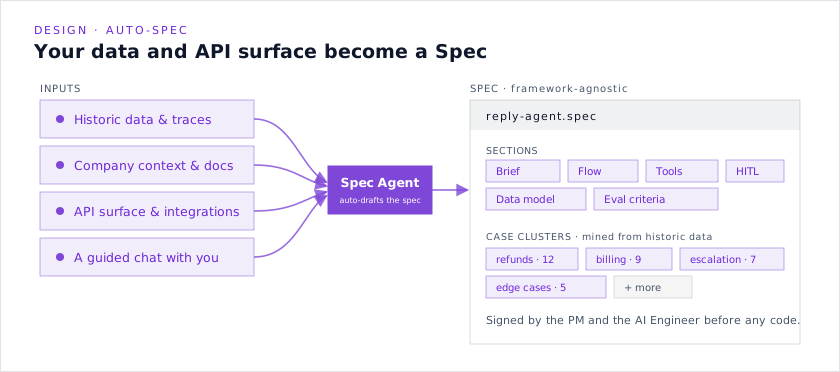
In a 30 minute interview, our agent picks the best architecture, organizes available context, maps tools, plans evals & dataset for a perfect plan from the beginning.
Available today as a guided design-partner engagement.












The expensive mistakes happen before the code.
Most agent projects lose weeks to the wrong architecture and tests that were never set up. Spec settles both up front.
From a blank page to a plan everyone signs
You answer a few questions. Spec turns them into the plan the whole build runs on.
Describe the agent
*specAnswer a few guided questions about the agent you want, instead of starting from a blank page.
Pick the architecture
Spec recommends the right architecture for the job and flags a poor fit before you build, not weeks later.
Learn from your code
Point it at an existing repo and it recovers the goal, scope, and problem, then checks them with you.
Write the tests first
The test cases and pass rules go into the plan, so good is defined before anyone writes code.
Everyone signs
agentspec.yamlThe team signs one plan. From there, changes flow one way, into the build.
All your data in. Any framework out.
Spec stays framework-agnostic, so you build the same plan against whatever you run on.
- Historic data and traces
- Company docs and context
- Your API surface
- A guided chat with you
 LangGraph
 LangChain
 OpenAI
 Claude
 Mastra
 VerceldeepagentsCrewAIraw API
What you can do with it
Right architecture
The best fit for the job, from proven patterns, not a guess.
Tests ready up front
Every case and pass rule defined before you build.
One agreed plan
Every stakeholder signs off before a line of code.
Nothing gets lost
Your docs, data, and past work, all captured.
Spec Agent vs A PRD or design doc
People reach for a product requirements doc or a design doc to define an agent. Both describe intent, but prose cannot be scored against, exported, or signed as a one-way contract. Here is where the Spec Agent differs.
Questions
Do I need an existing agent to run Spec?
No. Greenfield systems start from plain-English requirements and the guided pick-lists. If you already have an agent, Spec scans the codebase and reverse-derives the problem, goal, and scope, then asks you to confirm them.
Does Spec write my agent code or pick a framework for me?
No. Spec stops at the artifacts. It emits the framework-agnostic agentspec.yaml and the design sidecar. Writing code and choosing a framework is the job of the next stage, Build, which consumes the spec. Keeping design and implementation separate is what lets the same spec be built more than one way.
Does Spec run the evals?
No. Spec defines the eval criteria: the KPI, failure modes, and test rubric inside the design sidecar. Running the evals and measuring regressions belongs to Evaluate and Improve. Spec produces the rubric a regression harness needs to exist; it does not run the harness.
What kinds of agents does Spec support today?
The current version supports conversational, multi-turn agents only. Deterministic workflows, cron and event automations, single LLM calls, and multi-agent meshes are on the roadmap. If your agent is not conversational, Spec gates on the type check, stops, and tells you why it is not supported yet.
Why sign the spec once instead of keeping it editable?
The whole value is a stable anchor. Once the CTO and AI Engineer sign, changes flow one way from spec to code, so the architecture is not re-litigated every improvement cycle. The agent goes from a constantly-questioned artifact to a contract the rest of the lifecycle compounds against.
Is my agent locked to a specific framework?
No. The spec is framework-agnostic and never embeds framework syntax. The same spec can be built against LangChain, CrewAI, LangGraph, or raw API. If a framework fails you, keep the spec and rebuild the implementation against the same contract instead of re-defining the problem.
How does Spec connect to the rest of the lifecycle?
Spec is the entry point. Its signed contract feeds Build, which writes the code, and Evaluate, Diagnose, and Improve all score against the same eval criteria. The spec is the one contract every later stage compounds against.
How do I get started with Spec?
These agents are delivered as a guided design-partner engagement, not free self-serve. Book a walkthrough and we will run your first spec with you against a real agent. Diagnostics is the free self-serve entry point if you want to try one on your own first.
Get the plan right before you build.
Book a custom demo and we will spec a real agent with you.