Print fully tested, functional agents from spec to any framework
It uses a generator-verifier agent loop that keeps going until every capability is tested and verified.
Available today as a guided design-partner engagement.












Green tests do not mean the agent does what you asked.
AI-written code can compile and pass tests while a whole requirement is quietly missing.
Two agents in a loop, until the gate opens
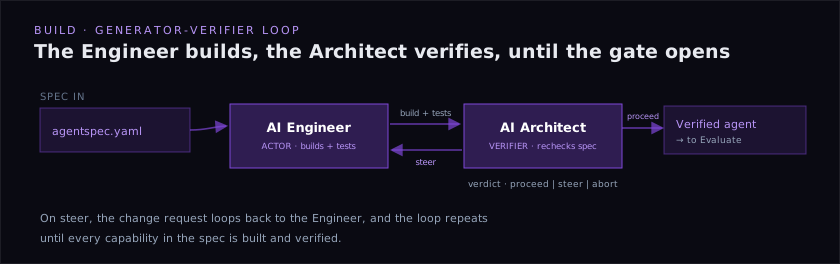
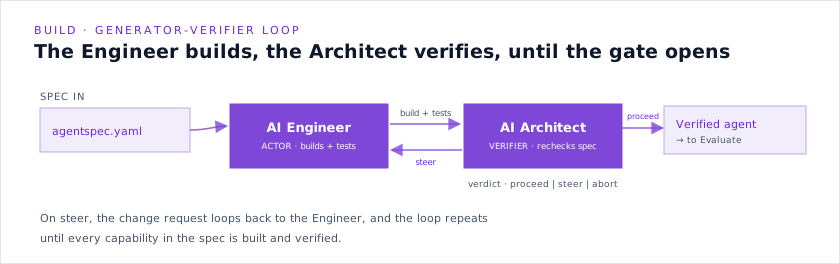
The AI Engineer builds, the AI Architect verifies, and the loop repeats until every capability is proven.
Read the spec
*buildBuild reads the signed spec and crawls your framework docs fresh, so it writes against the real API, not a guess.
The AI Engineer builds
The Engineer is the actor: it plans the layout, writes the tests first, scaffolds, and implements real code on your framework. It builds and amends, but never grades its own work.
The AI Architect verifies
A separate Architect is the verifier: it rechecks the build against the spec and docs, reruns the coverage itself, and returns one verdict, proceed, steer, or abort.
The loop closes the gaps
proceedOn steer, the change request goes straight back to the Engineer and the loop runs again, until every capability in the spec is actually built and tested.
Wire the tracing
Structured traces go in from the first run, so the rest of the lifecycle has something to read.
Built on the framework you already run.
Give Build the signed spec. It writes the agent as real code on your stack.
- The signed spec
- Your existing repo
- The model you picked
 LangGraph
 LangChain
 OpenAI
 Claude
 Mastra
 VerceldeepagentsCrewAIraw API
What you can do with it
Verified build
Every capability you asked for, checked as really there.
No silent drift
Model and framework changes show up as failing tests.
Reliable tool calls
Tested for real success, not just that they ran.
Traceable day one
Structured traces wired in from the first run.
Build Agent vs A code-completion assistant
People conflate Build with an autocomplete or code-completion tool. Both generate code, but only Build confirms that every requested capability is actually present. The faithfulness gate is the difference.
Questions
Is Build a skill or tool builder?
No. Build generates the agent itself from the signed spec on your existing framework and tool set. It composes tools that are already defined and registered, it does not mint new skills or custom tools. Creating skills is a separate product area.
How is this different from a code-completion assistant?
A completion tool suggests plausible next code and stops there. Build writes tests against the spec, iterates until they pass green, then runs a Verifier that traces the built agent against the spec to confirm every requested capability is actually present. Code can compile and pass unit tests while missing a requirement, and the faithfulness gate is what catches that.
What does the faithfulness review actually check?
The Verifier reads the signed spec and traces the built agent against it, enumerating each requested capability and confirming it is implemented with trace evidence. It produces a report listing every capability, a confidence score, and any unimplemented requirements, catching architecture mismatches, missing fallbacks, and wrong-parameter tool calls that tests alone cannot catch.
How does Build keep agents stable across framework and provider updates?
It creates a regression dataset during the build and writes tests that validate both output schema and semantics, not just that a response looks correct. When docs change or providers push updates, behavior drift shows up as a test failure instead of silent semantic rot in production.
Does Build catch every regression?
No. Its structural plus semantic test coverage catches most regressions, but silent semantic drift across very long workflows and model-reasoning changes invisible to a schema still slip through. Catching those in production is the job of the Evaluate and Diagnose stages, not Build.
What does Build not do?
It does not audit code-quality or style metrics like cyclomatic complexity or test-coverage percent, so code can pass every spec test and still violate your style standards. It does not choose or configure your observability backend, it wires the traces and you integrate them into your stack. It does not continuously optimize a running agent, that is the Improve stage, and it does not compose across multiple models, that is an Architect-stage decision. It needs a clear, signed spec: if the spec is incomplete or ambiguous, the Verifier will not catch that.
Where does Build sit in the lifecycle?
After Spec and before Evaluate. The observability and eval wiring Build lays down is the substrate the rest of the lifecycle runs on: Evaluate scores against it, Diagnose reads its traces, and the Improve inner loop returns to Build to apply validated fixes.
Who gets the most value from Build?
Mid-to-late-stage teams already running agents in production with observability. Early-stage teams building greenfield agents tend to get more immediate value from Spec clarity and Evaluate's feedback loop first.
Ship an agent you have actually verified.
Book a custom demo and we will build one from your spec, with you.